Saturday, March 10, 2018

Ancient Greek Dining

Tastes Of History started as experts in recreating Roman era cuisine.  The history of food, however, is one of continuity and so our repertoire has expanded to encompass other periods.  Unsurprisingly, given their Mediterranean roots, Roman cuisine was influenced by, and influenced, the ancient Greeks.

Best described as frugal, reflecting the difficulties that were faced in producing enough food on Greece's rocky and mountainous terrain, ancient Greek food is characterised by the "Mediterranean Triad" of wheat, olive oil and wine. Indeed, wine and olive oil have always been a central part of the Greek diet and the spread of grapes and olive trees in the Mediterranean and further afield is directly related to Greek emigration and colonisation.

Goat, sheep and pig meat was eaten, but rarely. Since most of Greece is close to the sea, fish and seafood were far more likely to be on the menu. Tuna, mullet, mackerel, snapper, octopus, squid, sea urchins and all varieties of shell fish, could all be grilled or baked. Such food could be supplemented with root vegetables, olives, goat's milk and goat's cheese. For the poor, however, barley gruels or porridge (kykeon) undoubtedly provided the staple diet.

The Greeks generally had three to four meals a day. A typical breakfast consisted of barley bread dipped in wine or olive oil, sometimes complemented by figs or olives. Pancakes made with wheat flour, olive oil, honey and curdled milk were also enjoyed. One kind of pancake made from a spelt flour dough is mentioned being topped with honey, sesame and cheese.

A quick, light lunch was taken around noon or early afternoon. Dinner, however, was the most important meal of the day being taken at nightfall. An additional light meal was sometimes taken in the late afternoon. Literally a "lunch-dinner", it effectively replaced the dinner meal.

Should you wish to recreate the cuisine of the ancient Greeks, then we hope the following recipes may serve as inspiration:


Friday, March 09, 2018

Dispelling a Myth: Mother's Day

Mother's Day: Not as sold  This Sunday (March 11th) saw that one chance each year to tell your mother how much she means to you (hopefully you don't need just one day per year to do that).  But why does the date change every year?  In the UK, Mother's Day falls on the fourth Sunday in Lent, which begins on Ash Wednesday, the day after Pancake Day - itself a movable date.  But Mother's Day may not be all that you think, especially given the overwhelming commercial hype that today obscures its origins.
Celebrations of mothers and motherhood can be traced back to the ancient Greeks and Romans, who held festivals in honour of the mother goddesses Rhea and Cybele.  But the clearest modern precedent for Mother's Day is the early Christian festival known as "Mothering Sunday".  Once a major tradition in the UK and parts of Europe, this celebration fell on the fourth Sunday in Lent and was originally seen as a time when the faithful would return to their "mother church" - the main church or cathedral nearest their home - for a special service.  Over time the Mothering Sunday tradition shifted into a more secular holiday, and children would present their mothers with flowers and other tokens of appreciation.  This custom eventually faded in popularity before merging with the American Mother's Day in the 1930s and 1940s.
In the Beginning  Cybele[1] was an originally Anatolian mother goddess.  She has a possible early Neolithic precursor at Çatalhöyük, in modern day Turkey, where the statue of a pregnant, seated goddess was found in a granary.  Cybele is Phrygia's only known goddess and was probably its state deity.  Her Phrygian cult was adopted and adapted by Greek colonists of Asia Minor and spread from there to mainland Greece and its more distant western colonies from around the 6th century BC.

In Greece, Cybele met with a mixed reception.  She was partially assimilated to aspects of the Earth-goddess Gaia, her Minoan equivalent Rhea, and the Harvest-Mother goddess Demeter.  Some city-states, notably Athens, evoked her as a protector, but her most celebrated Greek rites and processions show her as an essentially foreign, exotic mystery-goddess who arrives in a lion-drawn chariot to the accompaniment of wild music, wine, and a disorderly, ecstatic following.  Uniquely in Greek religion, she had a transgender or eunuch mendicant priesthood.  Many of her Greek cults included rites to a divine Phrygian castrate shepherd-consort Attis, who was probably a Greek invention.  In Greece, Cybele is associated with mountains, town and city walls, fertile nature, and wild animals, especially lions.

What did the Romans ever do?  In Rome, Cybele was known as Magna Mater ("Great Mother").  The Roman State adopted and developed a form of her cult after the Sibylline oracle recommended her conscription as a key religious component in Rome's second war against Carthage.  Roman mythographers re-invented her as a Trojan goddess, and thus an ancestral goddess of the Roman people by way of the Trojan prince, Aeneas.  With Rome's eventual hegemony over the Mediterranean world, Romanised forms of Cybele's cults spread throughout the Roman Empire.  The meaning and morality of her cults and priesthoods were topics of debate and dispute in Greek and Roman literature and remain so today.

The Romans also celebrated the Hilaria on March 25th, the eighth day before the Kalends of April, in honour of Cybele, the mother of the gods.  The day of celebration was the first after the vernal equinox, or the first day of the year which was longer than the night.  The winter with its gloom had died, and the first day of a better season was spent in rejoicing.  The manner of its celebration during the time of the Republic is unknown, except that Valerius Maximus mentions games in honour of the mother of the gods.  During the Imperial period, Herodian writes that, among other things, there was a solemn procession, in which the statue of the goddess was carried.  Before this statue were carried the costliest works of art belonging either to wealthy Romans or to the emperors themselves.  All kinds of games and amusements were allowed on the day; masquerades being the most prominent among them, and everyone might, in disguise, imitate whomsoever they liked.

Christian tradition  In the centuries that followed, Rome’s influence as the head of the Catholic church led, in Britain at least, to celebrating Mothering Sunday on the fourth Sunday of the Christian period of Lent, the 40 day period of fasting leading up to Easter.  It was intended for people to visit their main cathedral, or "mother church", rather than worship in their local parish.  Later domestic servants were given the day off to return to their home town or village and worship with their families.  But making the journey naturally led to family reunions that, over time, began to have greater significance.  This in turn has led to modern Britain's version of Mother's Day.
Much like “Trick or Treat” Halloween, the commercialised version that persists today is largely courtesy of the Americans.  Now known mostly for the giving of brunches of flowers, gifts, cards, and for general outpourings of love and appreciation, this was not what was first intended, however.

Tradition hijacked  In the 1850s, Ann Reeves Jarvis organised women to hold Mother's Day work clubs aimed at improving sanitary conditions in West Virginia, and to lower infant mortality by fighting disease and curbing milk contamination.  Between 1861 and 1865, the groups also tended wounded soldiers from both sides during the U.S. Civil War.  In the post war years Jarvis and other women organised Mother's Friendship Day picnics and other events as pacifist strategies to unite former Union and Confederate foes.

When Ann Reeves Jarvis died in 1905, her daughter Anna Jarvis was inspired to organise the first Mother's Day observances.  On May 10th, 1908 families gathered at events in Jarvis' hometown of Grafton, West Virginia - at a church now renamed the International Mother's Day Shrine.  They also gathered in Philadelphia, where Jarvis lived at the time, and in several other US cities.  The purpose was not to celebrate "all mothers", but rather the best mother each son or daughter had ever known - their own.  Indeed, this intention may explain why Jarvis stressed the singular "Mother's Day," rather than the plural "Mothers' Day”.

A new holiday  Largely through Jarvis's efforts, Mother's Day came to be observed in a growing number of cities and states until, in 1914, U.S. President Woodrow Wilson formally set aside the second Sunday in May as an official holiday.  Yet Anna Jarvis's idea of an intimate Mother's Day quickly became a commercial gold mine centred on the buying and giving of flowers, sweets, and greeting cards.  This development so deeply disturbed Jarvis that she set about dedicating herself, and her sizable inheritance, to returning Mother's Day to its more reverent roots.

She incorporated herself as the Mother's Day International Association and tried to retain some control of the holiday.  She organised boycotts, threatened lawsuits, and even attacked First Lady Eleanor Roosevelt for using Mother's Day to raise funds for charities.  In 1923, for example, she crashed a convention of confectioners in Philadelphia.  A similar protest followed two years later.  The American War Mothers had been using Mother's Day for fund-raising, selling carnations every year.  Jarvis resented that, so she crashed their 1925 convention in Philadelphia, and was duly arrested for disturbing the peace.

Jarvis's fervent attempts to reform Mother's Day continued until at least the early 1940s.  In a state of dementia, a penniless Jarvis finally died, aged 84, in Philadelphia's Marshall Square Sanatorium in 1948.

The holiday Anna Jarvis launched has spread around much of the world.  It is celebrated with varying enthusiasm, in numerous ways, and on different days - though rarely on the second Sunday in May.  One hundred years on and commercialism still overshadows the ancient spiritual beginnings, and the more recent reverent roots, of Mother's Day.  Perhaps Anna Jarvis had a point.

1.  (/ˈsɪbᵻliː/; Phrygian: Matar Kubileya/Kubeleya "Kubeleyan Mother", perhaps "Mountain Mother"; Lydian Kuvava; Greek: ΚυβέληKybele, Κυβήβη Kybebe, Κύβελις Kybelis).

Wednesday, March 07, 2018

Neolithic Feasting

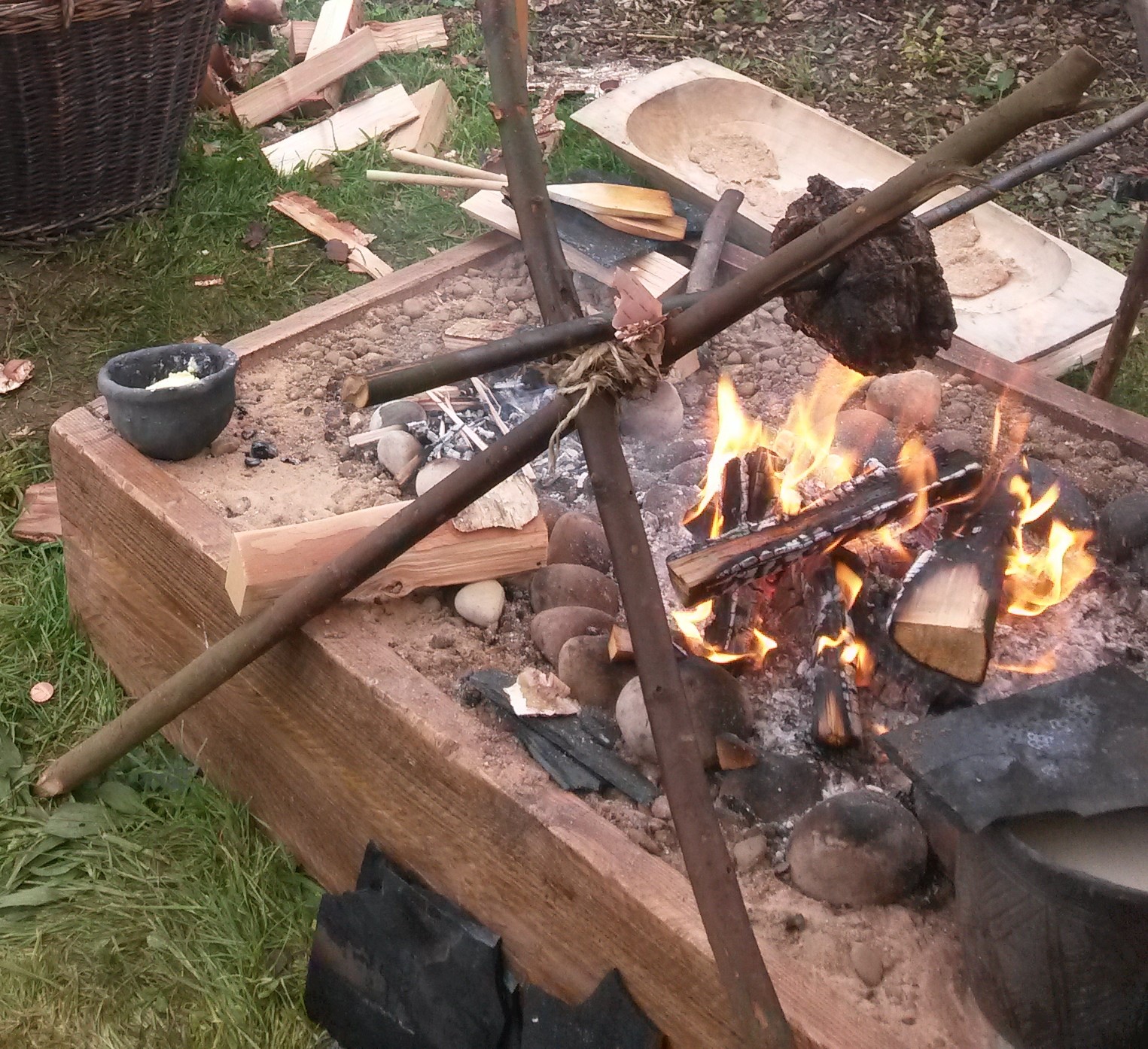
Our repertoire has expanded once more.  For twelve days in October last year, and again for nine days in February this year, we stretched our culinary expertise further back in time to the Neolithic period of some 4,500 years ago.  In support of English Heritage’s “Feast Exhibition” at Stonehenge (which runs until September 2018), our aim was to recreate some of what the builders of this ancient monument cooked and ate.

Durrington Walls  The discoveries at Durrington Walls, an ancient settlement two miles from Stonehenge, tell a story of feasting and ceremony, each one a clue to explain what our ancestors ate, how they cooked, where their food came from and how it reflects their spiritual and cultural values.
Better evidence for the domestication of cattle, pigs and sheep has emerged from excavations at Durrington Walls where over 38,000 discarded animal bones - probably representing at least 1,000 animals - were recovered.  Analysis of these bones has revealed a great deal about where food came from, and how people in the Neolithic period prepared their meals.

Of the bones and teeth excavated at Durrington Walls, 90% were from pigs, and the rest mostly from cattle. Many still had meat attached to them when they were discarded.  In its self this may not seem significant, but it does suggest that there was more than enough food to feed everyone.  Cut-marks, made by flint tools, on some of the cattle bones show the meat was clearly butchered, and burnt foot bones suggest that pigs were often roasted over open fires.

Roast Meat  For our part, we kept things simple by spit-roasting small joints of pork and beef.  This proved challenging outdoors in autumn and winter; cooking took far longer than expected.  Our experience was undoubtedly skewed by not being able to cook inside a roundhouse (for reasons of safety).  Given the time of the year, however, spit-roasting over a central hearth indoors probably would have been the norm.  Even so, taking all day to slowly spit-roast, or perhaps pit roast, a joint of meat makes some sense.
As dawn breaks, the embers of the fire are coaxed back to life.  After a simple breakfast, the men, women and children will set about their daily chores.  Those tending the hearth might be responsible for slow roasting the meat that will become the day’s main meal.  With people busy - hunting, gathering, caring for livestock, working in the fields, making or repairing things - frequent snacking, or grazing, may well have been the order of the day.  The idea of stopping for a defined midday meal appears a relatively recent creation.  By late afternoon or early evening, perhaps people returned home, gathering to enjoy the fruits of their labours and that slowly roasted meat.
Feasting  While we can to a certain extent generalise from the evidence at Durrington Walls, this was not regular, everyday consumption.  Instead, the evidence implies people were gathering and feasting at Durrington Walls, but why?  Many of the pigs had been killed at about nine months old which, since the piglets were most probably born in the spring, means they were being slaughtered in midwinter.  This suggests that people were gathering for feasts at that time of year to celebrate the seasonally important winter solstice.  But where did they all come from?
From stable isotope analysis, the relative amounts of different types of strontium, oxygen and sulphur in the animal bones and teeth can be measured.  In any creature’s formative years, including us, these elements are affected by geology, nearness to the coast, and climate.  This allows scientists to work out roughly where humans and animals were born and raised.
Analysis of the pig teeth from Durrington Walls suggests that some of the pigs were reared in west Wales, some in upland northern England and some even as far away as north-east Scotland.  The cattle teeth also suggest that these animals were not raised on the local chalk geology of rural Wiltshire.  All of which strongly suggests that the animals were most likely herded to the Stonehenge area.
Herding animals, even over relatively large distances, would have been much easier than slaughtering them first and transporting the carcasses.  Simple logic, yet it implies that people across Britain must have known about Stonehenge, where it was, and travelled there from afar, whether to help build the monument or to take part in ceremonies and feasts.  Moreover, it suggests there may have been far greater interconnectedness between Neolithic communities across the UK than one might have imagined.
Hunters, Gatherers and Farmers  By the late Neolithic period (3,000 to 2,300 BC), people in Britain had been farming for over 1,000 years, so they were expert at raising domestic animals for meat and milk, which seem to have been the most important elements of their diet and economy.  They also cultivated and processed cereals, although not on a large scale, and continued to gather wild foods such as mushrooms, berries and plants, and to hunt wild animals.
Apart from rare finds of preserved foods, our knowledge of what people 4,500 years ago were eating has been helped immensely by recent scientific developments.  When a pot is used for cooking, some of the food molecules seep into the porous ceramic material.  Scientists have recently developed new ways of chemically analysing pottery fragments to extract these trace residues and identify them.  At Durrington Walls, the pots were mostly found to contain pork and beef fats suggesting stews were popular.
Drink your Milk  About a quarter of the Durrington Walls Grooved Ware pots that were tested, however, were found to contain traces of dairy products such as milk, butter, yoghurt or cheese.  These products we duly recreated, with the soft cheese, together with a simple flat bread, proving to be particularly popular with Stonehenge’s visitors.  But wait.  We know that people in Britain at the time were lactose intolerant and did not having the ability to digest raw milk.  So why were pots found that had been obviously used to process milk into products like cheese and yoghurt?
Science Bit  Infant mammals nurse on their mothers to drink milk, which is rich in lactose.  In humans a gene known as LCT provides instructions for making the enzyme lactase (β-D-galactosidase), which is secreted in our intestines to digest lactose.  A specific DNA sequence in another gene (the MCM6 gene if you’re interested) helps control whether the LCT gene is turned on or off.  With the LCT gene “on”, the enzyme cleaves the lactose molecule into its two subunits, the simple sugars glucose and galactose, which can be absorbed by an infant to fuel growth.  Since lactose occurs mostly in milk, in most mammals, the production of lactase gradually decreases with maturity due to a lack of continued consumption after weaning.
This means that, having gained the developmental benefits of their mother’s milk, most mammals normally cease to produce lactase.  At least several thousand years ago, however, some humans developed a mutation in the MCM6 gene which keeps the LCT gene turned on even after breast feeding is stopped.  Such people are known as “lactase persistent” and can thus tolerate lactose in milk.  People who are lactose intolerant, or “lactase non-persistent”, do not have this mutation, and lacking lactase, consuming milk or other dairy products may cause adverse effects.
Confused?  To makes matters worse, genetically lactase non-persistent individuals can tolerate varying quantities of lactose before showing symptoms, and their symptoms differ in severity.  Most can digest a small quantity of milk, for example in tea or coffee, without suffering any reaction.
The simple answer to the Neolithic conundrum - lactose intolerance versus evidence for dairying - is that the processing of milk into products like butter, yoghurt and cheese significantly reduces the level of lactose.  For example:
·     The process of making butter largely removes lactose, albeit small quantities remain present; clarified butter contains a negligible amount of lactose.

·     Lactobacilli used in the production of yogurt remove lactose to varying degrees, depending on the type of yogurt.  Bacteria found in yogurt produce their own enzyme, lactase, which facilitates digestion in the intestines of lactose intolerant individuals.
·     Fermentation reduces the lactose content of cheeses, and aging reduces it further; traditionally made hard cheeses might contain 10% of the lactose found in an equivalent volume of milk.

So, the evidence from Durrington Walls offers important proof that humans in Britain were developing that familiar tolerance to lactose.  As a consequence, we spent much of our time making butter and a simple soft cheese from cow’s milk, which was flavoured with mint.  Although lots of other plants can provide tasty flavours, it seems that mint is one of only two herbs native to Neolithic Britain, the other being thyme.  The latter we used in a flat bread recipe to compliment the cheese and allow Stonehenge’s visitors to sample (if they wanted) Neolithic-style “bread and cheese”.

Supporting the Feast Exhibition proved to be an education for us as much as we hoped it was for visitors to Stonehenge.  The history of food provides an amazing continuity for the human story.  Our delight in discovering new foods or realising that we share so much in common crosses cultural barriers like nothing else.  Food and feasting, as embodied in the story of Stonehenge and Durrington Walls, simply brings people together.

Additional information:
Our storage and cooking pots were all hand-crafted by Graham Taylor of Potted History.
Flint tools were knapped by James Dilley of AncientCraft.

Our sincerest thanks go to all the staff at the Stonehenge Visitors Centre for making us feel so welcome.

The Wise Words of Gaius Petronius Arbiter


It may be a peculiarly military thing, perhaps it strikes accord with armed forces personnel, but one particular quote is frequently found pinned to office walls:

“We trained hard, but it seemed that every time we were beginning to form into teams, we would be re-organised. I later was to learn in life that we tend to meet any new situation by re-organisation; and a wonderful method it can be for creating the illusion of progress, while producing confusion, inefficiency and demoralisation.”

Despite shades of Brexit, these words of wisdom are usually ascribed to “Gaius Petronius Arbiter”, noted as a soldier, Centurion or sailor, and variously dated to 210 BC, AD 60 or AD 66. Typically the author is assumed to be the historical figure, Gaius Petronius Arbiter (alias Titus Petronius Niger; AD 27 - AD 66), a courtier and adviser on “elegance and taste” to the Emperor Nero. Scholars speculate that it was Petronius who wrote the “Satyricon”, a satirical novel dated to the Neronian period, and perhaps famous for the novo homo, or "new man”, Trimalchio and his infamous feast. Yet, despite his satirist credentials, there is no evidence for the Petronius origin. Indeed, scholars can find no hint of the quote in manuscripts or printed sources earlier than a magazine article that first appeared in 1957.

Today, it is strongly suspected that the author was a disgruntled British soldier (whether a commissioned officer or not is unknown) who pinned the quotation to a notice board in a British Army camp in occupied Germany some time after 1945. If nothing else, the style is highly suggestive of a British author, with a classical literary bent, but whoever it was certainly expressed an impeccable sentiment that seems equally at home when applied to military, government or academic administration. Perhaps this alone explains the quotation’s enduring appeal.

Tuesday, March 06, 2018

Stonehenge & the Solstices


Summer solstice  The Stonehenge monument in England is known for its alignment with the summer solstice sunrise, and it remains a popular destination for thousands of revellers welcoming the longest day of the year.  Indeed, the inner “horseshoe” of the monument opens toward the point on the horizon where the sun appears on the day in June when the sun’s path is furthest North.  But, was Stonehenge built to revere the summer solstice or is this a degree of wishful thinking on behalf of revellers and modern-day “druids”?  Certainly, one cannot argue that the monument is not aligned with the movements of the sun, and with the solstices specifically.  Yet, there seem to be two rather simple, and practical, objections.

Firstly, the Neolithic builders of Stonehenge, at least in its latter stages around 2,500 BC, are people who farm the land and were far more in tune with the seasons than most modern commentators.  As farmers, what relevance would there be for celebrating the summer solstice?  After all, the sun is shining (hopefully), the crops are growing, food is plentiful, and there’s far too much to be getting on with while the weather is favourable[1].

Secondly, and assuming the summer solstice is significant, as the June sun rises over the Heal Stone, does it not seem a bit odd to face towards sunrise and thus turn your back on the very monument you’ve laboured so many years to build?  While not improbable, this does seem an odd way of doing business.  The modern analogy would be to enter a typical Christian church, process down the nave towards the high altar and, once there, turn you back to it and completely ignore this fairly obvious focus of worship.  So, could there be another interpretation?

Winter solstice  On the same axis, in the opposite direction, is the point on the horizon where the sun sets on the winter solstice.  Experts currently suspect that the midwinter alignment may have been the more important occasion for the Neolithic people who built Stonehenge.  Which makes sense when you discover that the only megalithic monuments in the British Isles to contain a clear, compelling solar alignment are Newgrange and Maeshowe; both famously face the winter solstice sunrise.

The most recent evidence supporting the theory of winter visits includes bones and teeth from pigs which were slaughtered at nearby Durrington Walls, about two miles from Stonehenge.  Their age at death, nine months, is strong evidence that they were born in the spring, fattened through the year, and slaughtered in midwinter.  The extensive excavations at Durrington Walls, and comprehensive study of the wider archaeological landscape, has convinced Prof. Mike Parker Pearson of the University of Sheffield that, “We have no evidence that anyone was in the landscape in summer.”

So, it seems that watching the midsummer sun rising over the Heel Stone is almost certainly mistaken.  The viewing position was at the Heel Stone itself, outside the sacred space, and the chief celebration was that of the setting midwinter sun, seen through the narrow central corridor.  The sight of the last glint of winter sunlight through the centre of the black edifice must have been deeply moving.

Still not convinced?  From all the available evidence it is theorised that cycles in the skies were readily correlated with earthly cycles such as the seasons.  At the Neolithic passage tomb of Newgrange in Ireland, for example, the light of the sun shortly after dawn around the winter solstice shines directly into the interior through a roof-box above the entrance, lighting up a long passage and inner chamber that are usually in darkness.  An important connection clearly existed in people’s minds between the sun, death, ancestors, and (very likely) the annual process of renewal.  Thus, on the balance of probabilities, it is more likely that the winter solstice stood out as a time of renewal and regeneration - an idea that might resonant strongly with a farming community who, in the bleak depths of winter eagerly awaits the return of spring.  By midwinter, with an increasing reliance on stored provisions, how much better might people feel if there was a reason to gather, feast and celebrate with others.  Perhaps it not so surprising that midwinter festivals have had such a long cultural tradition; Christmas being just the most recent incarnation.


1.  Apart from henge building, livestock still need to be tended.  Crops need weeding.  Repairs can be effected to houses, field boundaries, tools and equipment.  All such things need to be completed before the frenetic days of harvest.

A pre-History of Lactose Intolerance

In support of English Heritage’s “Feast Exhibition” at Stonehenge, Tastes Of History was asked to recreate some of what the builders of this ancient monument in rural Wiltshire cooked and ate.  As a new departure for us, we had a lot to learn.  Moreover, as this was pre-history, we had to be almost exclusively reliant on archaeology and the most recent scientific research.  All of which led us to discover a previously unthought-of connection with lactose intolerance.

Lactose intolerance is the natural order of things for mammals such as ourselves.  This seems an anathema to most people living in Europe, and in those countries to which Europeans migrated and settled (USA, Canada, Australia, South Africa and so on).  Most of us are so used to drinking milk or eating dairy products without an adverse reaction that we consider this to be the norm.  Yet it is not.  Those who are lactose intolerant are in fact normal, while the rest of us are, quite simply, “mutants”.
Infant mammals, such as ourselves, nurse on their mothers to drink milk, which is rich in lactose.  A gene known as LCT provides instructions for making the enzyme lactase (β-D-galactosidase), which is secreted in our intestines to digest lactose.  A specific DNA sequence in another gene (the MCM6 gene) helps control whether the LCT gene is turned on or off.  With the LCT gene “on”, the enzyme cleaves the lactose molecule into its two subunits, the simple sugars glucose and galactose, which can be absorbed by the infant to fuel growth.  Since lactose occurs mostly in milk, in most mammals, the production of lactase gradually decreases with maturity due to a lack of continuing consumption after weaning.
So, having gained the developmental benefits of their mother’s milk, most mammals normally cease to produce lactase.  At least several thousand years ago, some humans developed a mutation in the MCM6 gene that keeps the LCT gene turned on even after breast feeding is stopped.  People who are lactose intolerant do not have this mutation, and lacking lactase, consuming milk or other dairy products may cause an adverse reaction.
Many people with ancestry in Europe, West Asia, South Asia, the Sahel belt in West Africa, East Africa and a few other parts of Central Africa maintain lactase production into adulthood.  This is known as lactase persistence.  In many of these areas, milk from cattle, goats, and sheep is used as a substantial source of food.  It was in these regions, therefore, that genes for lifelong lactase production first evolved, albeit relatively recently in the last 10,000 years.


Genetic analysis shows lactase persistence (lactose tolerance if you prefer) has developed several times in different places, independently.  As an example of convergent evolution, where similar features evolve in species of different lineages, this has led to more than 70% of western Europeans able to drink milk as adults, compared with less than 30% of people from areas of Africa, eastern and south-eastern Asia and Oceania.

Although its symptoms were described by the Greek physician and the "Father of Medicine", Hippocrates (460-370 BC), recognition of the extent and genetic basis of lactose intolerance is (understandably) relatively recent.  Until the 1960s, the prevailing assumption of western medicine was that tolerance was the norm and that intolerance was either the result of milk allergy, an intestinal pathogen, or else was psychosomatic (it being recognised that some cultures did not practice dairying, and people from those cultures often reacted badly to consuming milk).  There are two reasons for this perception:

·     Firstly, most western countries have a predominantly European heritage, so have low frequencies of lactose intolerance, and have an extensive cultural history of dairying.  Tolerance therefore was the norm in most of the societies investigated by medical researchers at that point.
·     Secondly, within even these societies, lactose intolerance tends to be under-reported: genetically lactase non-persistent individuals can tolerate varying quantities of lactose before showing symptoms, and their symptoms differ in severity.  Most can digest a small quantity of milk, for example in tea or coffee, without suffering any adverse effects.
Like most people, especially those of European descent, learning that our perceptions of lactose intolerance were quite wrong was a pleasing revelation.

Friday, January 05, 2018

Druids

A while ago we were approached for help in promoting "Britannia", a British historical drama scheduled to air on Sky Atlantic on January 18th, 2018.  Set in AD 43, the series follows "ancient Rome's conquest of the Celts in the British Isles - a mysterious land ruled by wild warrior women and powerful druids who can channel the powerful forces of the underworld."  We were to be part of a short promotional film involving "a light-hearted meeting between modern day druids and a Roman re-enactor to resolve this "two thousand year feud".  Sadly it did not come to fruition, but it got us thinking.  Apart from the erroneous reference in the synopsis to "Celts" in Britain - the Britons were not "Celts" - and "wild warrior women" (two possible subjects for later), who were these druids of which they speak?

19th century imagining of druidic ritual
Druids were priests who carried out religious rituals in Iron Age Britain and France.  So say the Romans who, having first visited and later conquered France and Britain, met "druids" and wrote about their beliefs and sacred rites.  Although these writings may not always have been completely accurate, or indeed truthful, it does seem clear that the druids were an important group of people in many Iron Age societies.

Much is written by modern commentators emphasising druids as being some sort of superior class of priests, political advisers, teachers, healers and arbitrators among the Iron Age tribes.  Yet little is really known about druidic influence, beliefs or rituals, including the importance of the iconic mistletoe.  Archaeologists rarely find definitive evidence for priests in the Iron Age, but they often reveal evidence of religious rites and sacrifices.  It is assumed many of these activities were carried out by the druids, but conclusive proof is scant.

There are no surviving images of druids, so can we say with any certainty what they looked like?  Did they wear special clothes or did they simply adopt contemporary Iron Age fashion?  Some archaeologists have argued that special head-dresses or crowns, such as that worn by the Deal Warrior, may have been worn by some priests or druids.  Yet even this is supposition.

It is abundantly clear, however, that the modern druidic revival, which started in the 19th century, has no direct connection to the priestly class of the Iron Age.  Many of the persistent popular ideas are based on misunderstandings and misconceptions of the scholars and amateurs enthusiasts of some 200 years ago.  There is, for example, no link between the Iron Age druids and the people who built and worshipped at Stonehenge.  This ancient Neolithic monument formed part of religious beliefs and practices that had ended long before the Iron Age - but try convincing self-styled modern "druids".

Modern day "druids" at Stonehenge
While the older myths have been superseded by later study and discoveries, the druids, as we understand them today, exist largely in the words of ancient Roman authors, especially Book VI of Caesar's "Commentaries on the Gallic War" (Commentarii de Bello Gallico).  It is from such Romans that we "know" the druids used both animal and human sacrifice, and that many of their observances centred on Oak groves and water.  Likewise, it is Roman historians who inform us that the Isle of Anglesey was a centre of druidic practice.

Complimentary or corroborating sources are suspiciously silent, however.  Thus, in a rather ironic echo of their oral tradition, much of what is accepted as the truth about druids is little better than hearsay.  The conclusive evidence stubbornly remains thin, but who knows what the science of archaeology may yet reveal.