Showing posts with label Myth. Show all posts

Wednesday, March 30, 2022

Dispelling Some Myths: 'ancient Roman trebuchet'?

A recent search of the internet for information on Roman artillery machines returned, amongst other results, a website with a page entitled ‘The Roman Trebuchet Catapults’ [sic]:

We have no idea of the premise behind this website. It is very basic in design, or perhaps just in its infancy, and seems focused on being an outlet for a slideshow presentation on ‘Slavery at the Time of the Roman Empire’, authored by Garrison Hibbs and Joseph Rethemeyer. Together with the website content, the slideshow is also very simplistic, including little in the way of detail, and appears aimed at a young audience. If we had to guess, it seems most likely this an American high school project made available online. That said, if this is a first attempt to publish to the internet or is a work in progress, then that’s great. The authors are to be commended for their entrepreneurial spirit and we are only too keen to encourage the development of their future talent. With that in mind, however, if anyone openly publishes information for others to discover that is misleading, then it deserves to be challenged (as part of the peer review process). What follows, therefore, are some observations on the 'facts' cited.


The first thing to address is the page's subtitle ‘Ancient Roman Trebuchet Catapult’. For now, we can safely overlook the word ‘catapult’ as the Roman Army did indeed deploy catapultae (sing. catapulta, ‘bolt-shooters’) alongside ballistae (sing. ballista, ‘stone-throwers’) in various guises to defend towns and cities, or for use in offensive siegeworks, or on the battlefield. As many as sixty of these artillery machines may have formed part of each legion’s arsenal.

No!  All well and good, but the second thing to consider is the historical context and specifically what time period is being addressed. True history begins with the adoption of writing systems to record events, people, places, etc. Everything before written records is ‘pre-history’. Even so, history covers an immense span of time that only grows longer with every passing day. As a subject for study, therefore, it has become convenient to divide history into the discreet, definable periods with which we are more familiar, such as the Iron Age, the Romans, the Anglo-Saxons, the Normans, and so on. The point of drawing attention to this ‘pigeon-holing’ of history is important because the author(s) specifically used the term ‘ancient Roman’ in their title. This is important because it more precisely defines at which point in the 1,000-year history of the Romans we are focused.

The Roman empire began in 27 BC and survived into the mid-15th century AD in the East, which is almost a millennium after it had collapsed in the West. The fall of Constantinople to the Ottoman sultan Mehmed the Conqueror in AD 1453 officially marks the empire’s end. Significantly, no historian today would define the 1400s as ‘antiquity’, and most would accept that the ‘ancient Roman’ world ended long before the empire’s final collapse. Yet there is still a problem agreeing when or at which point in its long decline represents the ancient empire’s physical demise.

Put simply, empires do not collapse overnight. Rome, for example, fell in a stages. The Sack of Rome by the Goths in AD 410, which saw many of the city’s finest buildings damaged, was followed by the invasion of the Vandals, who plundered the temples and took captives. The final blow came in AD 476 when a Germanic soldier, Flavius Odoacer, led a successful coup to depose the last western Roman emperor, Romulus Augustulus. So, for the purpose of history writing, and for convenience, it has become reasonable to date the end of ‘antiquity’ to the turning point year of AD 476.

No!  As highlighted in the screenshot (above), the page states: ‘The exact beginning of trebuchets is not known but we do know that they first started appearing around the 12th century.’ Having just defined that ‘antiquity’ effectively ended in the 5th-century, then using the terms ‘ancient Roman’ and ‘trebuchet’ in the same sentence is an obvious, and misleading, error. So if not ‘ancient’, were trebuchets known to the later Romans of the eastern or Byzantine Empire? It seems that they were, and a lot earlier than the 12th-century.

The Strategikon is one of the most extensive extant treatises on military tactics and strategies before the early modern period and is the basis for much of what we know about the 6th-century Roman army (Olster, 2013). Significantly, it refers to a more advanced kind of artillery, recently arrived in the Mediterranean world. The text uses the classical term ‘ballista’, but this new weapon was neither a torsion nor a tension powered weapon. Rather it was one operated by traction to launch projectiles using manpower pulling on ropes at one end of a rotating beam to propel a projectile placed in a sling at the other end, thereby satisfying the Stratigikon’s description of the weapon ‘revolving at both ends’ (Dennis, 1984, 139).

What is described therefore is a traction trebuchet, also known as a ‘mangonel’ [1], pictured right. Such weapons first appeared in China in the 4th-century BC before being carried westward by the Avars. The technology was adopted by the Byzantines in the late 6th-century AD, as the Stratigikon confirms, and by their neighbours in the following centuries.

Although it required more men to operate, it was also less complex and faster to reload than the torsion-powered onager [1] that it replaced in early Medieval Europe. The author of the Strategikon does not tell us when this new kind of artillery was introduced into the Byzantine Empire, but as the treatise was written sometime after AD 580 and before AD 610 (Olster, 2013), a 6th-century date does seem likely. Moreover, the historian of Emperor Maurice's reign, Theophylaktos Simokatta, provides information on when it came into use:

‘Bousas, a Byzantine soldier captured by the Avars, taught them how to construct a siege machine, for they were ignorant of such machines. And so he prepared the helepolis to shoot missiles. With this fearsome and skilful device the Avars attacked many Byzantine cities, levelling the fortress of Appiareia in 587 and ten years later attacking Thessaloniki, which successfully resisted.’

From this description, Bousas, and other Byzantine artillerymen, must have learned how to build and operate these weapons some years before AD 587. More importantly, we learn the name the Byzantines gave the new weapon: Helepolis.

In time the traction trebuchet was replaced as the primary siege weapon by the counterweight trebuchet, also known as the counterpoise trebuchet. This later, often larger and more powerful, weapon uses a counterweight to power the arm’s swing. It appeared around the Mediterranean in the lands controlled by Christians and Muslims in the 12th-century. Ironically, given the trebuchet's origin in the Orient, the counterweight trebuchet design was carried back to China by the Mongols in the 13th-century.

And No!  Finally we return to use of the term ‘catapult’. Technically trebuchets and catapults are not the same thing. How they operate can largely be differentiated by how the machine stores energy and how that energy is subsequently used to project a missile. Before the advent of gunpowder, there were three principal ways of achieving a mechanical advantage in launching a projectile:

Tension: The most familiar tension weapon is the bow. From the Stone Age onward, arrows shot from bows have been advantageous in outranging spears/javelins, throwing sticks or simple rocks to engage targets safely from distance whether in the hunt or on the battlefield. To shoot, the archer holds the bow at its centre with one hand and pulls back (draws) the arrow and the bowstring with the other (typically the dominant hand). This flexes the two limbs of the bow rearwards, which perform the function of a pair of cantilever springs to store elastic potential energy. Typically while maintaining the draw, the archer aims the shot intuitively or by sighting along the arrow. When the archer releases (looses) the draw, the limbs' stored energy is released and converted into kinetic energy transmitted via the bowstring to the arrow, propelling it forward with high velocity.

Torsion: The power of a bow is measured by its draw-weight [2]. For example, bows shot by historical re-enactors typically have draw-weights of between 50 and 70 lbs. In comparison, some of the Tudor warbows recovered from Henry VIII's flagship, the Mary Rose, have draw-weights in excess of 120 lbs marking them as clearly more powerful. There is, however, a limit to the draw-weight that can be pulled by the archer’s muscles alone. The introduction of torsion weapons sought to overcome this limitation, yet how and when this transition occurred remains a mystery. What is clear is that torsion - the twisting of an object by applied torque - offered much greater efficiency over tension based weaponry.

The bow was discarded in favour of ‘two wooden frames around each of which was wrapped strand after strand and layer after layer of sinew-cord’ (Marsden, 1969, 17). The two resulting bundles of sinew, each with its own frame, formed the springs. Into the middle of each of these springs was inserted a solid, tapering wooden arm. The arms were connected by a strengthened bowstring. As the bowstring is drawn rearward, typically by some form of mechanical device such as windlass, ratchet and pawl system, the arms apply torque to the sinew-cord springs overcoming inertia and thereby storing elastic potential energy. When the bowstring is released, the springs rapidly unwind to resume their resting position, accelerating the arms in a forward rotating arc. This in turn accelerates the bowstring forward imparting kinetic energy to propel the missile. Ballistas, catapults and scorpions, and other single-armed missile projectors such as the onager, all use torsion power.

Traction: The earliest trebuchet, however, as described in the Strategikon, were powered by traction whereby manpower pulling on ropes at one end of a lever used the mechanical advantage of said lever to throw a projectile. Once again, the range of traction trebuchets was limited by the strength of the men pulling the ropes. Not only that but the difficulties of coordinating the pull of several men repeatedly and predictably eventually made the adoption of the counterweight trebuchet preferable even though these machines were much larger, more complicated to engineer, and thus more expensive to field. The counterweight trebuchet’s advantage, however, was using gravity to provide the throwing power.

Potential energy is stored by slowly raising an extremely heavy box (filled with stones, sand, or lead) attached to the shorter end of the lever, typically a wooden beam hinged about an axle (the fulcrum of the lever). When released, the box descends rapidly prescribing an arcing path and the force so generated causes rotational acceleration of the beam around the axle. These factors multiply the acceleration transmitted to the throwing portion of the beam and its attached sling contain the projectile. As the beam arcs forward, the sling initially follows the same path but as the beam reaches it apogee, the sling continues to accelerate transmitting the increased speed to the projectile. The length of the sling increases the mechanical advantage, and also changes the trajectory so that, at the time of release from the sling, the projectile is traveling in the desired speed and angle to give it the range to hit the target. Adjusting the sling's release point is the primary means of fine-tuning the range, as the rest of the trebuchet's actions are difficult to adjust after construction.

The rotation speed of the throwing beam increases smoothly, starting slow but building quickly. After the projectile is released, box and the arm continue to oscillate, until the weight of the box acts as a brake to slow the rotation and bring the beam to rest, typically upright. This is unlike the violent sudden stop inherent in the action of other catapult designs such as the onager (see right), which must absorb most of the kinetic energy into its own frame, and must be heavily built and reinforced as a result. This key difference makes the trebuchet much more durable, allowing for larger and increasingly more powerful machines.

A conclusion of sorts?  As stated earlier, this is not intended to be a dismissive critique of somebody else’s work. Rather, we hope it sets the record straight and explains why, in history terms at least, to connect ‘ancient’ and ‘Roman trebuchet’ is inaccurate and misleading. Moreover, it is hoped that readers can understand that while bows, catapults and trebuchets are all missile projectors, they use very different technologies to achieve the desired effect.

As ever, feel free to comment, like and share.

References:

Dennis, G.T. (transl.), (1984), Maurice's Strategikon, Handbook of Byzantine Military Strategy, Philadelphia, p. 139.

Olster, D., (2013), ‘Strategikon of Maurice’, Wiley Online Library, Available on-line: https://doi.org/10.1002/9781444338386.wbeah03227 (accessed March 27th, 2022).

Endnotes:

1. Two common misconceptions about the mangonel are that it was a torsion siege engine and that it is synonymous with the earlier onager.

2. A bow’s draw weight, also known as poundage, is a measurement used to determine how much force is required to flex the bow and draw its bowstring a standard length of 28 inches. Traditionally, the bow would have been held on a tiller and pound weights hung on the bowstring until it was drawn the required 28”. In this manner, a bow with a 70-pound draw weight takes 70 pounds of force to reach the standard draw length.

Wednesday, March 02, 2022

Dispelling Some Myths: Cooking in a Shield

Farinata (‘made of flour’), a classic Italian street food, apparently enjoys two provenance myths according to BBC History Magazine [1]. One version from Mediæval times holds that Genoese sailors happened upon this tasty treat when barrels of chickpea flour and oil, which had spilt on their ship’s deck, mixed with seawater and the concoction baked in the sun. However unbelievable the sailors’ yarn might be, the second, and much earlier tale, claims Roman soldiers discovered what would become known as farinata by baking chickpea flour on their shields. This origin story is quoted in the Bradt Travel Guide to Liguria, where farinata is also said to be the region’s ‘oldest dish’ (Whitehouse, 2016, 35). But the source of the legend is not cited, so, can there be any truth to the alleged Roman origin? We think not, for one very simple reason...

A novel idea  The idea of cooking on or in a shield reminded us of a scene in Lynsey Davis’ Falco novel ‘Venus in Copper’. In the book, the eponymous hero, Marcus Didius Falco had been promised a turbot by the emperor’s son, Titus Caesar. Falco half-jokingly invites Titus to sample the fish after he has had a chance to cook it. Then, when the huge turbot arrives Falco does not have a pot or pan of sufficient size to cook it. He ends up using a bronze round shield as poaching pan. The shield, however, is described as a cheap knockoff tourist souvenir that his brother Festus had previously acquired. Yet it is noteworthy that, although a decorative piece, the ‘shield’ was of bronze. Contrast that with the actual shields carried by Roman soldiers.

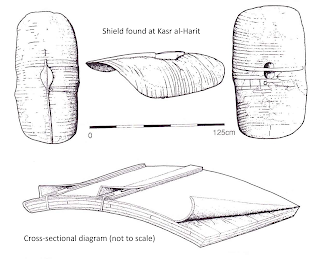
The Roman scutum  A large, curved plywood shield excavated at Kasr al-Harit in the Egyptian Fayyum was originally identified as belonging to a mercenary serving with the Ptolemaic forces. Its size and shape, however, is remarkably similar to the sculptural representations of shields carried by soldiers on the altar of Domitius Ahenobarbus (below) and the monument of Aemilius Paullus (Bishop & Coulston, 2006, 61).


The Greek historian Polybius, writing in the Hellenistic period of 264 BC - 146 BC, states the Roman infantry shield was convex and measured 1.18 m (4 feet) long by 0.74 m (2½ feet) wide, with a thickness of a palm’s breadth at the rim. He described its construction as follows (Polybius, Historia, VI.23):

‘The Roman panoply consists firstly of a shield (scutum), the convex surface of which measures two-and-a-half feet in width and four feet in length, the thickness at the rim being a palm's breadth. It is made of two planks glued together, the outer surface being then covered first with canvas and then with calf-skin. Its upper and lower rims are strengthened by an iron edging which protects it from descending blows and from injury when rested on the ground. It also has an iron boss (umbo) fixed to it which turns aside the most formidable blows of stones, pikes, and heavy missiles in general.’

By comparison, the shield found in 1900 at Kasr al-Harit (pictured) was 1.28 m long and 0.635 m wide. It was fashioned from three layers of wooden strips, possibly birch wood. The inner vertical strips were overlaid front and back with horizontal layers, to produce a curved plywood shield that was thicker at the centre than at the edges. The nine or ten vertical strips measured between 60 and 100 mm in breadth; the forty horizontal ones were 25 to 50 mm. Both inner and outer surfaces were covered with lamb’s wool felt, but the edges were not reinforced with metal. The shield had a wooden ‘barleycorn’ boss with a vertical rib (spina) attached with iron nails above and below it on the shield face and a horizontal handgrip behind the boss.

Over time the large, oval shield of the Republican period was altered to become the iconic square-edged, rectangular version. As shown below, first the curved top and bottom edges were cut square, then the curved sides followed suit. For the next two hundred years or so this convex, rectangular shield remained in use until almost wholly replaced by round shields, which had become much more common by 4th-century AD.

Regardless of the changes to its size and shape, the construction of Roman shields remained consistent. In other words, the shields were made of wood, covered in felt, leather and/or linen - all materials that are clearly flammable. It is therefore unbelievable and highly improbable that Roman soldiers ever cooked chickpea flour, or indeed any of their rations, in or on their shields.

References:

Bishop, M. C. and Coulston, J. C. N., (2006), ‘Roman Military Equipment: from the Punic Wars to the Fall of Rome’ (second edition), p. 61.

Polybius, Historia (‘The Histories’), Book VI.23 (‘The Roman Military System’), Lacus Curtius, Available on-line: https://penelope.uchicago.edu/Thayer/E/Roman/Texts/Polybius/6*.html (accessed February 28th, 2022).

Whitehouse, R., (2016), ‘Liguria’, Bradt Travel Guides, Available on-line: https://books.google.co.uk/books?id=tSSICwAAQBAJ&pg=PA35&redir_esc=y#v=onepage&q&f=false (accessed March 2nd, 2022).

Endnotes:

1. BBC History Magazine, August 2019, ‘History Cookbook: Farinata’, p. 86.

Wednesday, May 05, 2021

Dispelling Some Myths: Dirty water? Drink beer!


For some reason it is often stated on popular television programmes that Mediæval Europeans drank lots of wine, ale or beer all day, every day because the local water was dirty or somehow fouled. Unfortunately for those repeating this myth, there is plenty of evidence that people regularly drank water. After all, what was the town, village or castle well for?

Water is a basic need for human survival, together with food and shelter. What is true today has been so since antiquity. In truth, very few civilisations have not been established near a source of clean water. The ancient Egyptians had the river Nile. The Assyrian and Babylonian Empires flourished between the rivers Euphrates and Tigris in Mesopotamia [1].

The Spartans had the Eurotas, while for the Romans it was the Tiber. Nearly all European capitals are founded on or near rivers. To name but three: Parisiennes have the Seine, Londoners the Thames, and Buda and Pest sitting on either bank of the mighty Danube became the Hungarian capital of Budapest.

Medieval cities and water supply  There was a very good reason why the Mediæval forerunners of these modern capitals were sited near a water supply. As the 15th-century architect Leon Battista Alberti noted: “a city required a large amount of water not only for drinking, but also for washing, for gardens, tanners and fullers, and drains, and in case of sudden outbreak of fire, the best should be reserved for drinking, and the remainder distributed according to need” [2].

The importance of drinking water is evidenced by the recorded efforts of local leaders to give people access to it. Writing in the 7th-/8th-century AD, the Benedictine monk, Bede noted that King Edwin of Northumbria, “established a benefit for his people in that in many places where clear springs or streams ran by well-used roads, where they were most frequented he ordered posts with bronze cups hung on them to be set up for the refreshment of travellers.” Scroll forward in time and it becomes clear that cities in Mediæval Europe were spending large amounts of money on creating and maintaining water supplies. In 1237, for example, the City of London acquired the springs of the Tyburn and built a small reservoir, a head of water, to help serve the city with a steady, free, flowing supply. Eight years later work began on the Great Conduit, a man-made underground channel that brought drinking water from the Tyburn to Cheapside in the City. Londoners were at liberty to draw water but even so wardens were appointed to stop them taking too much, the unpermitted taking or diversion, and to repair pipes. There are also records for the City noting the expenses related to maintaining and cleaning the Great Conduit. Yet despite this example, the myth of constant beer drinking persists.

Absence of evidence
  There may be a simple explanation. There are few references to people drinking water in the surviving Mediæval letters and chronicles. Instead, such sources speak of drinking ale or wine. Perhaps water drinking was so mundane it was just not worth mentioning. If truth be told few historians in the past rarely recorded the ordinary things that would be familiar to their readers. Rather, they focused on relating the novel, different or strange. That Mediæval authors seldom wrote about a love of water, does not mean people avoided drinking it.

The benefits of drinking water from a good source are often noted in Mediæval medical texts and health manuals. There are numerous references to when one should drink water or add it to another drink. The 7th-century Byzantine physician, Paul of Aegina, for example wrote: “of all things water is of most use in every mode of regimen. It is necessary to know that the best water is devoid of quality as regards taste and smell, is most pleasant to drink, and pure to the sight; and when it passes through the praecordia [stomach] quickly, one cannot find a better drink” [2]. In a similar vein, the Regimen sanitatis Salernitanum [3] advises drinking from a cool spring was good for thirst but adds that rainwater was even better. The treatise does caution against drinking water during a meal to avoid its chilling effect on the stomach. Wine, it notes, should be preferred.

Being on bread and water
  As well as medical texts, Mediæval religious manuscripts also mention provide further evidence of drinking water. Many of the saints, for example, are chronicled abstaining from drinking alcohol preferring water instead. Some of the more austere monastic communities advocated relying solely on water. Moreover, it became a standard practice throughout the Mediæval period for people to atone for their sins on a diet of bread and water. If said water was polluted, then it would be rather sadistic of the church to compel the penitent to risk illness or death. Rather, the idea of “bread and water” was clearly intended to limit those seeking repentance to a bland diet, but one sufficient to sustain life while discouraging further minor transgressions [4].

Ale or Water?  Water has always been the stuff of life. Access to good sources of clean water was prized and throughout history great efforts were undertaken to supply people with water not only for drinking but for washing, sewerage, firefighting and so on. People in the Middle Ages clearly understood that not all water was safe to drink. It was common knowledge that obtaining water from marshy areas or places of standing water was to be avoided. They also knew that, when making ale or beer, the boiling of the mash during the brewing process usefully killed any harmful bacteria in the water. Moreover, the mash gains nutrients from the barley and other ingredients, and the microorganisms can also produce vitamins as they ferment. For many people, therefore, the drinking of ale or beer was an excellent nutritional supplement.


So, it is true that people in Mediæval Europe drank large quantities of ale or beer during the day [5], but not necessarily for inebriation or because the water was unfit to drink. Rather beer drinking provided daily sustenance. Of course, where a water source was polluted, then it made perfect sense to consume ale or beer. But if water could be drawn from a good source, then people would commonly drink it. The myth it seems reveals more about our misunderstanding of the past. With more contemporary references to wine, ale and beer drinking than to water it would be easy to see how the “dirty water” idea might take hold. But people in the Mediæval period did drink water and, because it was such a normal and mundane thing to do, they, like us, simply did not boast about it.

Notes:

1. Literally “[land] between rivers” from the ancient Greek Μεσοποταμία which is formed by the root words μέσος (mesos, “middle”) and ποταμός (potamos, “river”).
2. “Did people drink water in the Middle Ages?”, Medievalist.net, retrieved April 17th, 2021.
3. The Regimen sanitatis Salernitanum is a Mediæval didactic poem believed to have been written in the 12th- or 13th-century. Even though the book bears the name of the famous mediæval medical school, the Schola Medica Salernitana, it is not certain if it originated there.
4. Chevalier, J., (2013), “The great Mediæval water myth”, Les Leftovers, retrieved April 17th, 2021.
5. In the 12th-century, the strength of ales and beers varied and were identified by marking with single, double or triple X’s. Lighter ales might be drunk earlier in the day and the heavier, stronger one later.
6. Marks, T., (2018), “A sip of history: ancient Egyptian beer”, The British Museum Blog, retrieved April 18th, 2021.

Pompeii, Bodies and Assumptions

Last year, on Saturday November 21st, 2020, the Italian culture ministry announced to the world’s media that archaeologists have discovered the exceptionally well-preserved remains of two men scalded to death by the volcanic eruption that destroyed the ancient Roman city of Pompeii in AD 79. Unsurprisingly this led to usual flurry of media stories.
Those shown are only a small sample but all have one thing in common: all pronounced the younger man was a "slave". He may well have been, but that is a bold claim. So, we thought we would read the news releases and gather the evidence, What quickly becomes apparent is that each media outlet is simply rewording a single press release from the Archaeological Park of Pompeii. So, despite the appearance of multiple sources, the presented evidence is, well, uncorroborated.

The new find is located in Civita Giuliana, about 686 metres (750 yards) northwest of Pompeii’s city walls. Being on private property, government-commissioned excavations only began at the villa in 2017, when archaeologists stepped in to help prevent looters from tunnelling into the site and stealing artefacts. During this latest series of excavations the two bodies were found. It is likely that the victims were seeking refuge from the inundation of ash and pumice resulting from the eruption of Mount Vesuvius. At about 9 o'clock on that fateful morning, the two were caught in the pyroclastic current of superheated volcanic debris that swept through the town, Their clenched feet and hands - the "pugilists stance" [1] - clearly demonstrates how the men died.
The intense heat destroyed soft tissue, but the men's teeth and bones were preserved. The subsequent voids left by the soft tissue was filled with plaster, left to harden, and then excavated to reveal the outline of their bodies. Examination of the resulting plaster casts has allowed researchers to evaluate the clues. The researchers believe the figures are those of a young slave and a richer older man, presumed to be his owner, based on the vestiges of clothing and their physical appearance. One of the men is described as aged between 30 and 40, and of "high-status". This assessment seems to be based on his "stronger" bone structure, particularly around his chest area, and that he was wearing a tunic and had traces of a woollen cloak under his neck. The stronger build might be indicative of a better diet but that is speculative at best; there is no guarantee that both men did not have access to similar food. As to his clothing, he is wearing garments typical of most Roman men in the first century AD. The cloak, for example, is sensible outer wear for someone contemplating or attempting to escape the town. So, the only way to link his apparel to a "higher-status" would be by analysis of the weave to show it was of finer quality. This, however, has either not happened, perhaps because the casting does not provide the necessary detail, or the results have yet to be made public. There is no suggestion that the actual material survived.

It was revealed that the younger man was probably aged between 18 and 25. Like the older man, he too is thought to have been wearing a pleated tunic, possibly made of wool. Again, it would be extremely difficult to determine the younger man's status based on his clothing. However, it was noted that he exhibited several compressed vertebrae, and it is this observation that seems to be the only reason the experts to believe he was a manual labourer or slave. Both explanations are clearly plausible, but neither can be definitively proven. One could speculate that by being a labourer he may have been susceptible to just such a back injury. Certainly, osteoarchaeologists note that repetitive manual tasks, performed over time, often result in identifiable skeletal joint wear. Equally, of course, it may have been an accidental injury. The point is that neither of these simple premises lead to a conclusion that he was a "slave". The honest answer is that we will never truly know who these two men were or their relationship. But that does not sell the story.

Notes:

1. The "pugilists stance" is typically seen in severely burned bodies and characterised by flexion of elbows, knees, hips and neck, and clenching of hands into fists. This is caused by high-temperatures from fires, resulting in muscle stiffening and shortening.