Monday, July 29, 2024

On This Day: The Spanish Armada is sighted

July 29th, 1588: On this day in 1588, the fearsome Spanish Armada is sighted off England’s southern coast.


In late July of 1588, La Grande y Felicísima Armada - literally the “Great and Most Fortunate Navy” - sailed from Lisbon, a port city on the Atlantic coast in modern Portugal. This daunting war fleet was bound for England. The popular version of events - the one most likely found in school texts books - is that Philip II of Spain, deadly foe of Queen Elizabeth I of England, sent his huge Armada of ships to invade and return England to the Catholic faith. But the Spanish fleet was defeated by the plucky little English navy, whose courageous captains included Sir Francis Drake. It was crowning achievement of Elizabeth’s reign and a defining moment in English history - the moment we took on Europe and won! Or so the story goes because the popular version is not entirely true.

Philip, King of England

In 1588, Philip was 61, a devout Catholic and king of the largest empire in the world, reaching from South America to the Philippines. Elizabeth was in her 50s, still unmarried, still childless and ruling over a Protestant England in which Catholic plots were a constant threat. But in 1554, 34 years earlier, Philip had set sail from northern Spain to become part of the Tudor royal family. We often forget that before he was king of Spain, Philip II - the great villain in the Armada story - spent four years as king of England due to his marriage to Mary, Elizabeth’s older half-sister. Mary was desperate to secure England’s future as a Catholic country and dreaded the thought that she might die childless and leave the Protestant Elizabeth to take the throne. Philip, however, felt differently.

The alternative to Elizabeth, in the event of his and Mary’s marriage producing no children, was Mary, Queen of Scots. She was a Catholic, which was a plus, but due to her ancestry and close ties to the French court, she would have taken England firmly into the orbit of Philip’s French enemies, which was intolerable. Thus, the king of Spain rooted for his sister-in-law, persuading Mary to release Elizabeth from house arrest. When Mary lay dying, Philip realised, or at least believed, that the only way he could persuade Elizabeth to support Catholics was to marry her and get her to convert. And so, he proposed. Elizabeth, as ever, refused to commit herself. A few months later, hearing that Philip had “moved on” and started negotiations to marry a French princess, Elizabeth is quoted as saying: “He couldn’t have loved me all that much if he couldn’t wait a month or two for an answer.” Even so, despite the proposed match never happening, Elizabeth and Philip remained friends.

Why was the Spanish Armada launched against England? 

Over the next ten years, as Elizabeth and England became decidedly Protestant, there were rumblings from Rome. In the late 1560s, Catholics in northern England attempted an unsuccessful rebellion. To encourage them further, on February 25th, 1570 Pope Pius V (Jan 1566 - May 1572) excommunicated their Queen declaring "Elizabeth, the pretended Queen of England and the servant of crime", to be a heretic - a non-believer in the Catholic faith - and released all her subjects from any allegiance to her, even when they had "sworn oaths to her", threatening to excommunicate any that obeyed her orders. Elizabeth now had a big target on her back. In the eyes of the church any English Catholic who rebelled against their Queen, or indeed killed her, would not have committed a “sin” and would be forgiven.

Philip was now under pressure from the Pope in Rome to topple Elizabeth, but with his vast empire to run, he had plenty of other priorities. Religion alone was not a strong enough reason for Philip to invade England. Even so, it is still alleged that the Spanish king supported plots to have Elizabeth overthrown in favour of her Catholic cousin and heir presumptive, Mary, Queen of Scots. These plans were thwarted when Elizabeth had Mary imprisoned. After eighteen and a half years in custody, in 1586 Mary was found guilty of involvement in a Catholic plot to assassinate the English queen. It is said Elizabeth reluctantly signed the death warrant that saw Mary beheaded the following year, 1587, at Fotheringhay Castle near Oundle in Northamptonshire. With Mary, Queen of Scots dead, Philip preoccupied with his empire, and religious differences not a strong enough reason to invade, what triggered the Spanish attack?

Protests and Privateers

Two things tipped Philip’s hand. Firstly, Elizabeth supported Philip’s rebellious Protestant subjects in the Low Countries (Belgium, the Netherlands, and Luxembourg). Secondly, Elizabeth was funding privateers to plunder Spanish ships across the Atlantic. At the time Spain had colonies in the Americas and ships would cross the ocean to Spain laden with treasure - gold, silver, jewels, etc. The treasure ships were tempting targets for a cash-strapped English monarch.

Elizabeth issued Letters of Marque and Reprisal authorising attacks or the capture of enemy vessels and shipping during wartime. Individuals or ships in possession of such Letters were known as “private men-of-war” or Privateers. Significantly, privateering was a way of mobilising armed ships and sailors without having to spend treasury resources or commit naval officers. Moreover, privateers were of great benefit to a smaller naval power or one facing an enemy dependent on trade as they disrupted commerce and pressured an enemy to deploy warships to protect merchant trade against such “commerce raiders”. Usefully for a penny-pinching court the cost was borne by investors hoping to profit from prize money earned from captured cargo and vessels. The proceeds would be distributed among the privateer's investors, officers, and crew.

Cruising for prizes with a Letter of Marque was considered an honourable calling combining patriotism and profit, in contrast to unlicensed piracy, which was universally reviled. It has been argued that privateering was a less destructive and wasteful form of warfare, because the goal was to capture ships rather than to sink them. English adventurers Thomas Cavendish (ca. AD 1555-ca.1592), Francis Drake (ca. AD 1540-1596) and John Hawkins (AD 1532-1595) were celebrated privateers. Though each had Letters of Marque and Reprisal, Cavendish was the only one who confined his raids to wartime. Regardless, the Spanish and other nationalities regarded all three as pirates who, in contrast to privateers, committed warlike acts at sea without the authorisation of any nation.

Philip’s Response

Philip was goaded into action. He planned an expedition to invade England, overthrow Elizabeth and, if the Armada was not entirely successful, at least negotiate freedom of worship for Catholics and financial compensation for war in the Low Countries. Through this endeavour, English material support for the United Provinces, the part of the Low Countries that had successfully seceded from Spanish rule, and English attacks on Spanish trade and settlements in the New World would end. Importantly, the King was supported by the Pope, who treated the invasion as a crusade, with the promise of a subsidy should the Armada make land. As a devout Catholic, Philip thus felt it was his duty to invade and conquer England in order to convert the country back to the Church of Rome.

On July 21st, 1588, the Armada of 141 ships outfitted with 1,500 brass guns and 1,000 iron guns, and carrying ca. 10,000 sailors and 19,000 soldiers, set sail from Lisbon headed for the English Channel. The full body of the fleet took two days to leave port.

In the Spanish Netherlands, 30,000 soldiers awaited the arrival of the Armada, the plan being to use the cover of the warships to convey the army on barges to a place near London. In all, 55,000 men were to have been mustered, a huge army for that time. Meanwhile the English fleet stood prepared, if ill-supplied, at Plymouth, awaiting news of Spanish movements.

Bowls anyone?

You may have heard it was while Sir Francis Drake enjoyed a game of bowls on the greens of Plymouth Hoe that the Spanish Armada was first sighted on the horizon. The usual story has Sir Francis turning to Lord Effingham, commander of the English fleet, and saying that there was no need to hurry, there would be plenty of time to finish the game and thrash the Spaniards too.

Disappointingly none of the early accounts of the Armada mention anyone playing bowls at all. It was about 25 years later that one account - just one - finally describes sailors in Plymouth in July 1588 “dancing, bowling, and making merry” on the shore as the Armada appeared. Yet it is such an irresistibly juicy detail that, in the 1730s, a biography of Sir Walter Raleigh tells us that Drake was determined to finish his game of bowls - and from then on it became “history”.

Invincible fleet?

The Spanish fleet that Philip assembled is usually depicted as an “invincible” Goliath to England’s little David of a navy. In reality it was anything but. It was not even the biggest fleet ever to have attacked England: the Norman invasion fleet of 1066, and the French force that crossed the Channel in 1545 and sank the Mary Rose, both boasted more vessels. The Spanish had around 130 ships, but nearly half of these were not built as warships. Rather they were used for duties such as scouting and dispatch work, or for carrying supplies, animals and troops. Surprisingly the English fleet actually outnumbered that of the Armada by some 200 ships to 130. Nevertheless, the Spanish fleet outgunned that of the English, with its available firepower being 50 percent greater than that of the enemy.

The “invincible” Armada had sailed into trouble long before it had an opportunity to engage its English foes, however. Soon after departing from Lisbon in May 1588, they faced disease, rotting food and bad weather. Storms forced four galleys and one galleon to turn back, and other ships had to put in for repairs at A Coruña in northern Spain. From there, the commander of the fleet, the Duke of Medina-Sidonia, wrote to Philip confessing that he could see “hardly any of those on the Armada with any knowledge or ability to perform the duties entrusted to them…we are very weak”. Philip insisted the invasion had to go ahead so, in July, the Armada set sail once more with the intention of navigating the English Channel towards its narrowest point. There it was to meet with an army of soldiers from the Netherlands led by the Duke of Parma, who were to be ferried across on barges to invade Kent. In the end only about 124 ships actually made it to the English Channel where the two fleets eventually met. Once again, the Spaniards began to experience more problems. Their first major casualties were self-inflicted: a crash and explosion lost two Spanish ships.

Battle is joined

The Armada was sighted in England on July 29th, when it appeared off the Lizard in Cornwall. The news was conveyed to London by a system of beacons that had been constructed along the south coast. The same day the English fleet was trapped in Plymouth Harbour by the incoming tide. The Spanish convened a council of war, where it was proposed to ride into the harbour on the tide and incapacitate the defending ships at anchor. From Plymouth Harbour the Spanish would attack England, but Philip explicitly forbade Medina-Sidonia from engaging, leaving the Armada to sail on to the east and toward the Isle of Wight. As the tide turned, 55 English ships set out to confront the Armada from Plymouth under the command of Lord Howard of Effingham, with Sir Francis Drake as vice admiral. The rear admiral was John Hawkins.

At daybreak on July 31st, the English fleet finally engaged the Armada off Plymouth near the Eddystone rocks. In two further encounters, off Portland Bill on August 2nd and off the Isle of Wight on August 4th, the English harassed the Spanish fleet at long range and easily avoided all attempts to bring them to close action. Given the Spanish advantage in close-quarter fighting, the English ships used their superior speed and manoeuvrability to keep beyond grappling range and bombarded the Spanish ships from a distance with cannon fire. However, the range proved too great for the manoeuvre to be effective, and at the end of the fighting neither fleet had lost a ship in action.

Fire ships!

By August 7th, the Armada was anchored off Calais in a tightly packed defensive crescent formation, not far from Dunkirk, where the Spanish army, reduced by disease to 16,000 men, was expected to be waiting. The army was not ready, and the Spanish fleet found itself increasingly vulnerable to attack. At midnight on August 7th/8th, the English set alight eight fireships, sacrificing regular warships by filling them with pitch, brimstone, gunpowder and tar, and cast them downwind among the closely anchored vessels of the Armada. The Spanish feared that these uncommonly large fireships were “hellburners”, specialised fireships filled with large gunpowder charges that had been used to deadly effect before. Two fireships were intercepted and towed away, but the remainder bore down on the fleet. The Armada's flagship and the principal warships held their positions, but the rest of the fleet cut their anchor cables and scattered in confusion. No Spanish ships were burnt, but the crescent formation had been broken, and the fleet now found itself too far downwind of Calais in the rising south-westerly wind to recover its position. The English closed in for battle.

At dawn on August 8th the English attacked the disorganized Spanish ships off Gravelines, and a decisive battle ensued. Retaining its superior maneuverability, the English fleet provoked Spanish fire while staying out of range. The English then closed, firing damaging broadsides into the enemy ships. The ships were close enough for sailors on the upper decks of the English and Spanish ships to exchange musket fire. Many of the Spanish gunners were killed or wounded by the English broadsides, and the task of manning the cannon quickly fell to the regular foot soldiers who were unfamiliar with their operation.

After eight hours, the English ships began to run out of ammunition, and some gunners began loading objects such as chains into cannons. Around 4 pm, the English fired their last shots and pulled back. Five Spanish ships were lost and many others severely damaged in what is known as the Battle of Gravelines. The Spanish plan for the fleet to link up with its army had been decisively disrupted.

“Stomach of a King”

Once the Armada was sailing northward up the Channel, the day after the battle off Gravelines, the next popular myth appears. It is the story of Elizabeth’s rousing address to her men at Tilbury on northern bank of the Thames. Her famous speech in which the Queen tells the assembled troops that she may: “have the body of a weak and feeble woman, but the heart and stomach of a king - and of a King of England too” has been dramatized in countless films. Elizabeth is often depicted riding a horse, dressed in white velvet, or even in armour. “I myself shall be your general“, she tells her men.

Once more, all is not what it seems. Elizabeth had indeed come up with the plan to address the troops while the Spanish were still in the Channel. Yet by the time she did so, it was 11 days too late, and the Armada was already staring defeat in the face - off the coast of Scotland!

Even better, the economy was struggling, and England was broke. Elizabeth could not afford to pay her troops and had to send them home. Fortunately, by the end of 1588 half of the English force were facing death from disease so, as Elizabeth’s chief advisor, William Cecil, put it: “If they’re dead, you don’t have to pay them.”

So, when Elizabeth uttered her famous words at Tilbury, what was left of the Armada was on its way home.  The only option left to the Spanish ships was to return to Spain by sailing round the north of Scotland and home via the Atlantic or the Irish sea.  

What also aided the English in defeating the Armada?

The Spanish ships were beginning to show wear from the long voyage, and some were kept together by having their damaged hulls strengthened with cables. Supplies of food and water ran short.

Off Scotland and Ireland, the fleet ran into a series of powerful westerly winds which drove many of the damaged ships further toward the shore. Because so many anchors had been abandoned during the escape from the English fire-ships off Calais, many of the ships were incapable of securing shelter as the fleet reached the coast of Ireland and were driven onto the rocks where local inhabitants looted the ships.

More ships and sailors were lost to cold and stormy weather than in direct combat. About 5,000 men died by drowning, starvation, and slaughter by local inhabitants after their ships were driven ashore on the west coast of Scotland and Ireland. Reports of the passage of the remnants of the Spanish Armada around Ireland abound with onerous accounts of hardships and survival. In the end 67 ships and fewer than 10,000 men survived.

Why is the 1588 battle with the Spanish Armada so famous? 

The English story of the Armada is one of rumour, spin and outright lies! With the action all taking place at sea, and communication from the English fleet to shore being pretty much useless, no one at home knew what was actually happening. Likewise, events were blown out of all proportion because, again, no one really knew what had happened. In the end people believed what they wanted to believe and the “fake news” - or “tabloid truths” - still resonate with us today.

In England, the boost to national pride from the defeat of the Spanish invasion lasted for years and Elizabeth's legend persisted, and grew, long after her death. Yet the Armada’s defeat did not bring victory in the war with Spain; in fact, that conflict dragged on into the 17th-century.

The English Armada 

The Spanish never really saw the Armada as a significant setback. That was because the English suffered an embarrassing naval disaster of their own in 1589. That year, Sir Francis Drake led a so-called “Counter Armada”, with the aim of destroying the remainder of Philip’s fleet while it was under repair in Santander. It was a fiasco, in which 15,000 Englishmen died, and many of the 86 ships were lost. Drake and his fleet were forced - just like Philip II’s own fleet a year earlier - to stop at A Coruña for lack of provisions. Here, a local woman, Maria Pita, led fierce resistance against the English navy.

Legacy

The legend of the defeat of the Spanish Armada created by the Tudors, and retold by generations after them, has had a powerful legacy. In times of crisis, from the Second World War to the Falklands Conflict in 1982, it has been used to convince Britons that this small island can take on superpowers, that we come from a long line of cool-headed and inspirational leaders, and that, small as we are, we can still play a mighty role on the world stage. True or not, this populist version of the Armada story convinces many to believe in that fantasy. Who knows where this impressive mingling of facts, fantasy, and fibs might take us next? Why does Boris’ Brexit spring to mind..? Bon appétit!

Wednesday, July 24, 2024

About History: Press-ganging

Impressment, colloquially known as ‘the press’ or the ‘press gang’, was a means by which European navies could forcibly compel men into service during the 17th century and up to the early 19th century either to crew their fleets at the outbreak of war or to replace men lost to death or desertion. Essentially no different to conscription employed by the British Army, the Royal Navy’s system began in 1664, although the practice can be traced back to the time of King Edward I of England. Impressing was intended to solve a basic problem during wartime that there were never enough professional seamen to crew both a fully mobilised navy and the merchant fleet.

By modern standards, the average 18th century sailor experienced harsh working and living conditions in the Royal Navy. The size of a naval crew was determined by the number needed to man a warship’s guns. In Nelson’s navy this was typically about four times more than the number of crew needed to simply sail the ship. With so many more sailors, life aboard would lack basic privacy and the cramped, unhealthy conditions increasing the risk of illness and disease spreading through the crew. On lengthy voyages, shipowners and governments routinely estimated that 50% of the sailors would die due to scurvy. Yet, for many the food supplied by the Navy was plentiful, regular, and of good quality by the standards of the day. So, in the late 18th and early 19th centuries, it was not at all unusual for impressed men to view life in the navy, hard though it was, as preferable to their previous lives on shore. Volunteering for further service when the opportunity came to leave the ship was not at all unusual.

What is more, naval pay in the 1750s remained an attractive prospect for many men, even though its value would be steadily eroded by rising prices as the century progressed (Roger, 1986, 137). Naval wages had been set in 1653 and were not increased until April 1797 after the Spithead mutiny by sailors of the Channel Fleet. Moreover, the Royal Navy was notorious for paying wages up to two years in arrears, that is until reforms in the 19th century improved conditions. The Navy also employed a policy of always withholding six months' pay to discourage desertion. In comparison, the pay on merchant ships was somewhat higher during peacetime and could increase to double the naval rate during wartime [1]. Despite the disparities, there were still many volunteers for naval service. 


The main problem with naval recruitment, especially during wartime, was a shortage of qualified and experienced seamen. The Royal Navy had to compete with the Merchant Navy and privateers to recruit from a small pool of ordinary and able seamen leaving all three groups short-handed. The Navy’s solution was to impress ‘eligible men of seafaring habits between the ages of 18 and 55 years’, but this included many merchant sailors as well as men from other, mostly European, nations. Men could be impressed ashore or directly from ships at sea. Non-seamen were sometimes impressed as well, though rarely; the Navy had little trouble recruiting unskilled ‘landmen’ by using the simple expedient of offering them a bounty. The recruitment figures presented to Parliament for the years 1755–1757 list 70,566 men, of whom 33,243 were volunteers (47%), 16,953 pressed men (24%), while another 20,370 were listed as volunteers separately (29%) (Hill, 2002, 135–137). Precisely what the distinction was between “volunteer” and “pressed man” is not recorded. It is likely that those who "volunteered" did so to get a sign-up bonus, two months' wages in advance and a higher rating in the Navy, which came with a commensurately higher wage. Volunteers were also protected from their creditors as British law forbade collecting any debts accrued before enlistment. One significant difference between volunteers and pressed men centred on the punishment meted out to those who deserted. If captured, volunteers were liable to execution while pressed men were simply returned to service (Hill, 2002, 135–137).

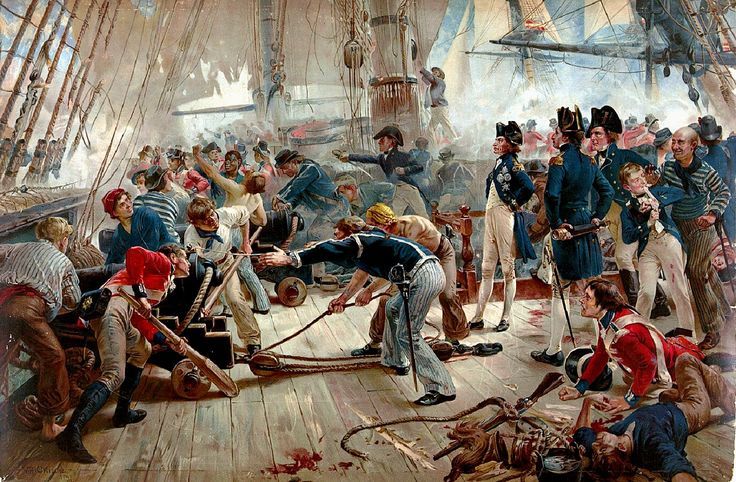
The popular image of press gangs, as illustrated right, is one of men being forcibly taken. While violence might have been threatened it was rarely used as dead or injured seamen were of no use to the Royal Navy. The last recorded press was in 1814 towards the end of Britain’s long war with Napoleon Bonaparte’s France, yet press-ganging remained legal for another 50 years. Despite a public campaign for abolition, the government retained the right to impress until the 1860s when it finally created an effective Naval Reserve to crew the fleet in an emergency.


References:

Hill, J. R., (2002), ‘The Oxford Illustrated History of the Royal Navy’, Oxford: Oxford University Press.

Lambert, A., (2023), ‘How common was press-ganging?’, Q&A, BBC History Magazine (July edition), p. 37.

Rodger, N.A.M., (1986), ‘The Wooden World: An Anatomy of the Georgian Navy’, New York: W. W. Norton and Company.

Endnotes:

1. During the 18th century, after deductions a Royal Navy Able Seaman was paid the princely sum of 22 shillings and 6 pence per month. As the Navy used a 28-day lunar month, the sailor’s annual rate of pay was somewhat more than 12 times this. In contrast, a farm worker of the era might earn around only a quarter to a third as much. However, wages on merchant ships were higher: 25 to 30 shillings per lunar month, and this increased further during wartime (merchant pay rates of 70 shillings per month at London and 35 shillings at Bristol were offered during the Seven Years' War). That said, dishonest ship-owners routinely cheated merchant crews of their pay in several ways (Roger, 1986, 124-136).

Wednesday, May 29, 2024

Dispelling Some Myths: Wreckers and smugglers

Wrecking

Wrecking is the practice of taking valuables from a shipwreck which has foundered or run aground close to shore. Wrecks were frequent in Devon and Cornwall where the rocky coastline, and strong prevailing onshore winds helped wreck many merchant ships and warships. A tradition still exists that, during the 17th and 18th centuries, wreckers deliberately decoyed ships on to coasts using tricks, especially false lights, so that they ran aground for easy plundering. While this has been depicted in many stories and legends, there is no clear evidence that it has ever happened probably because such tricks simply would not work. Sailors are wary of running aground so in all probability false lights would be interpreted as indicating land and thus avoided if they cannot be identified. Moreover, a burning beacon or lantern cannot be seen very far over water at night, unless they are large, fitted with mirrors or lenses, and mounted at a great height – like a lighthouse. If anything, wreckers would surely have extinguished any warning lights to increase the chances of a ship foundering.


To prove the point, in episode 2 of the first series of the 2005 BBC documentary “Coast”,  the team attempted to replicate the conditions of wrecking by rigging a false light. The experiment concluded that a single-candle lantern onshore would be insufficient to lure a boat into dangerous water on a dark night. Indeed, the boat crew did not see the light until they got within 150m of it and at which point the dangers of being too close to the shore would be apparent. Yet despite the evidence, or lack thereof, in 1735 it was made an offence to make false lights. Ultimately no one was ever prosecuted under this law, but in 1769 William Pearse was hanged at Launceston in Cornwall for stealing from a wreck. Note, however, that the offence was stealing not wrecking.


Rather than a deliberate act, the temptation to plunder wrecks has remained a strong motivation for Britons living in coastal communities. Wrecking was a major activity of the inhabitants of Stroma Island in the Pentland Firth off the north of Scotland. It was also well known on the Goodwin Sands off the southeast of England where over 2,000 wrecks have occurred. The boatmen of Deal, who took supplies to ships at anchor off the coast, would plunder any wrecked vessel. None of which should be surprising as, throughout history, ordinary folk have always tried to improve their lot by fair means or by ‘bending the law’. By UK law, goods from wrecks are supposed to be reported to the "Receiver of Wreck" and finders will then be given a reward. In January 2007, however, the container ship MSC Napoli, seriously damaged in a storm and sinking, was deliberately beached off Branscombe in Devon. When some of its cargo was washed ashore, many people, some travelling long distances, plundered the cargo regardless of attempts to prevent them. Even so, and although it has a long history, wrecking has never been as prevalent as one might think, and the lurid tales might suggest.

Smuggling 

On the other hand, the evidence for Britons engaging in smuggling throughout the centuries is rife, with smuggling and wrecking inextricably linked. In Cornwall, for example, the sight of a ship foundering would bring the nearby population to the beach. With pickaxes and hatchets a ship would be dismembered and any goods on it carried away. Likewise, any goods washed ashore from a wrecked ship were regarded as common property and, in Cornwall, would quickly become part of the Cornish smuggling trade.

According to Historic UK contributor Ellen Castellow, at one point ‘it was estimated that more illicit spirits were being smuggled into the country than came through London Docks’. But why should this be so? To set the scene, we should consider what life was like for the common folk in 17th and 18th century Britain. An untimely death was ever-present. For example, it should be no surprise that the plague outbreak that struck London in 1665 resulted in more than 7,000 fatalities. Yet other diseases also took their toll. Smallpox was prevalent, killing thousands and disfiguring many more. A significant number of people throughout the country who had survived the disease would have been recognisable from the unmistakable “pockmarks scarring their faces (Rennison, 2020). According to contemporary records for London in the late 17th century just over 100 deaths were ascribed to ‘spotted fever’; 134 to ‘consumption’; 64 to ‘convulsion’; 51 to ‘griping in the guts’ and some 43 women died in childbirth (Rennison, 2020). Added to that were the records for one-off accidents: one man was ‘burnt in his bed by a candle at St Giles Cripplegate’ while another was ‘killed by a fall from the belfry at All-Hallows-the-Great’ (Rennison, 2020).

Tuberculosis was another prolific killer, its symptoms exacerbated by the smoke and poor air blanketing London making the city quite the unhealthy place to live. Pollution of all kinds was ever present, and smog was not just a consequence of the Industrial Revolution. The burning of sea-coal in domestic fires meant that 17th century London was as foul-smelling and filled with sulphurous smoke as the later Victorian city. Adding to the general malaise would have been the mostly narrow, packed, and filthy streets. Drainage was poor - in some areas non-existent - and faeces, both human and animal, befouled the roads (Rennison, 2020). The same poorly lit streets were also a haven for footpads and robbers. For ordinary Britons struggling to survive in a dangerous world, one in which life was cheap and death could be just around the corner, with few legal protections but a myriad of laws carrying the death penalty, it is easy to see why “breaking the rules” might seem an attractive, perhaps even necessary, proposition.

A coastal tradition

As Britain became embroiled in a series of Continental Wars during the 18th and into the 19th century, high duties were needed to finance a number of extremely expensive wars with France and the United States. The high rates of duty levied on tea, wine and spirits, and other luxury goods imported from mainland Europe at the time made the clandestine import of such goods and the evasion of the duty a highly profitable venture for impoverished fishermen and seafarers. In certain parts of the country such as the Romney Marsh, East Kent, Cornwall and East Cleveland, smuggling was for many communities more profitable than farming and fishing. Allied to this “the shortage of able-bodied men for home service, coupled with official corruption, allowed smugglers to do very much as they liked, and so they carried on their job in open defiance of the law” (Castellow, 2023). 

So, during the 17th and 18th centuries, especially in southern England, smuggling was simply a part of daily life and traces of the illicit trade can be widely found. Poole in Dorset for example, with its convenient harbour, was one of the greatest smuggling towns on the southern English coast during the 18th century. Tea was landed from passing East Indiamen and brandy, silk and lace arrived in huge quantities from France and the Channel Islands all to avoid paying import taxes. The men of Poole even colluded with smugglers in Sussex and with those from the West. When a seizure of tea was made in 1747, it was the Hawkhurst gang from Sussex who openly attacked the Custom House in Poole and recovered it (Castellow, 2023). Further east, when the Peter Boat Inn at Leigh-on-Sea in Essex was reconstructed about 80 years ago, a warren of secret chambers was discovered which were clearly intended to store smuggled goods. Elsewhere in Essex, and for centuries until the 1800s and early 1900s, a favourite landing place for contraband was Brandy Hole Creek on the River Crouch. The location was well known for the smuggling of wine, brandy and even tea. Indeed, once landed, the brandy (hence the name "Brandy Hole") was taken south and east across Daws Heath near Rayleigh in shrimp-carts and onward to London.

Lurid tales and ghost stories were employed to disguise smuggling activities or discourage the inquisitive. During the 19th century, secret chambers in the ruins of Hadleigh Castle in Essex were supposed to have been used to hide smuggled goods. It was during this time that the castle got a reputation for being haunted by the “White Lady”. She would reputedly appear before a shipment of illicit liquor arrived, and miraculously disappear when all the contraband had been moved on.

The Revenue men

The job of combating smuggling was entrusted to Revenue Officers (also known as Revenue Men, Customs Officers or Customs Men). Under the "Excise Ordinance" of 1643 [2], the Long Parliament established both the Board of Customs responsible for collecting duties levied on imported goods, and the Board of Excise responsible for raising revenue from inland taxes. While it was from this point that the raising of excise duties began, the levying of customs duties has a far longer history. Originally, the term “customs” meant any customary payments or dues of any kind to, for example, the king, or a bishop, or the church. Later the term became defined as duties payable to the king on the import or export of goods. The first written reference to customs duties occurs in an 8th century charter of King Aethelbald, but the first centralised English customs system can be traced to the reign of King John. The Winchester Assize of Customs of 1203 established that customs were to be collected and paid to the State Treasury. His Majesty’s (HM) Customs was established on a more permanent basis with the passing of legislation known as the nova custuma of 1275 in the reign of King Edward I. The nova custuma levied duties on exported wool and leather, and alongside this duty was also levied on imported goods which, from the 14th century, became known as tonnage and poundage [1].

Unlike customs, excise duties are in-country duties levied on articles at the time of their manufacture, such as alcoholic drinks and tobacco. As already mentioned, excise duties were first levied in England in 1643, during the Commonwealth. These were initially on beer, cider, spirits and soap, with duties later levied on such diverse commodities as salt, paper and bricks. For a time, the Board of Excise was also responsible for collecting the duty levied on imports of beverages such as rum, brandy and other spirits, as well as tea, coffee, chocolate and cocoa beans. Before the duty was paid, such commodities were often stored in a bonded warehouse where excise officers could assess and measure them, a regulatory measure that still happens today.

From the early 17th century, the searching of vessels for illicit goods, known as “rummaging”, was undertaken by customs officers. The flow of contraband continued unabated however until late in the century a concerted effort was made to tackle the growing problem. Land-based Riding Officers were employed to patrol the coast on horseback, while Revenue cutters were provided to enable officers to intercept vessels involved in smuggling at sea. All the while the “cat and mouse” game between smugglers and the Revenue Men played out around the coastline. Ideally, in any such venture, violence was to be avoided but when it could not, many bloody, desperate fights with the Revenue Men took place in the lonely creeks (Castellow, 2023). As Ellen Castellow remarks: “an entire boatload of Excise-men were found with their throats cut on the Sunken Island near Mersea [Essex] in the early 1800’s. They now lie buried beneath their upturned boat in Virley churchyard.”

Throughout the 19th century the organisations or agencies involved in anti-smuggling operations evolved to something resembling that which we have today (see InfoBox opposite). Now operated by His Majesty’s Revenue and Customs (HMRC), a fleet of Customs Cutters still operate throughout UK territorial waters inspecting vessels for Prohibited and restricted goods. Increasingly they are also dealing with immigration matters, although border enforcement is primarily the responsibility of the UK Border Force.

Has anything changed?

Some may think that in the present-day smuggling has ceased, but it clearly has not. Illegal drug trafficking, and the illegal arms trade, as well as the historical staples of smuggling, alcohol (rum-running) and tobacco remain widespread. Those involved are able to impose a significant price premium on smuggled goods as they face significant risk of civil and criminal penalties if caught with contraband. Regardless, the enormous potential proceeds from smuggling and selling on contraband goods make the risks worthwhile. Profit is also derived from avoiding taxes or levies on imported goods. A smuggler might purchase a large quantity of cigarettes in a place with low taxes, smuggle them into a place with higher taxes and sell them at a far higher margin than would otherwise be possible. Yet beyond the organised smuggling operations, ordinary Britons still find themselves tempted to bend the rules. Over the years how many packs of cigarettes or bottles of spirits have been hidden in an “innocent” holidaymaker’s suitcase? Is this the acceptable face of modern-day smuggling?

As for wrecking, one of the most recent examples to happen in Britain, the container ship MSC Napoli mentioned earlier, is quite revealing. After containers from the wreck began washing ashore, about two hundred people went onto Branscombe beach in Devon to scavenge the flotsam. Goods including 17 BMW motorcycles, empty wine casks, nappies, perfume, and car parts were taken despite police warnings that those responsible risked fines for failing to notify the Receiver of Wreck of the goods salvaged. The "salvage" free-for-all was tolerated for a while until January 23rd, 2007 when the police branded the activity of scavengers "despicable", closed the beach, and announced that they would use powers unused for a century to compel those involved to return the goods they had taken without informing the authorities. These actions, Devon Police pointed out, constituted an offence equivalent to theft under the Merchant Shipping Act 1995. Ironically, in October 2007, salvagers who had reported their finds to the Receiver of Wreck were told they could keep what they found. Regardless, it seems people never really change, and old habits die hard. Britons have, after all, a long history and great deal of experience in the art of wrecking and smuggling. Bon appétit.

Reference:

Castellow, E., ‘Smugglers and Wreckers’, Historic UK, Available online (accessed December 13th, 2023).

Rennison, N. (2020), ‘Coffee, plague and the Great Fire: the pleasures and perils of living in Restoration London’, BBC History Extra, Available online (accessed December 13th, 2023).

Endnotes:

1. Tonnage and poundage were duties and taxes first levied in Edward II's reign on every tun (cask) of imported wine, which came mostly from Spain and Portugal, and on every pound weight of merchandise exported or imported.

2. Titled “Ordinance for the speedy raising and levying of moneys by way of charge or impost upon several commodities”, the act was passed by the Long Parliament which lasted from 1640 until 1660.

Monday, May 20, 2024

The Recipes: a Mediaeval Joust

After several years of wishing we could be involved a chance encounter while “pirating” in Scarborough has led to Tastes Of History’s first performance at the Royal Armouries Museum in Leeds, Yorkshire. We were delighted to offer a taste of mediæval food to spectators at the live-action International Jousting Tournament over the Easter bank holiday weekend. 


From Friday 29th March to Monday 1st April the museum’s impressive jousting arena resounded to the cheers of crowds and the clash of lances on armour, as knights battled it out in an authentic mediæval jousting tournament. A truly international event, this year teams from the United Kingdom, France and Italy competed for honour and trophies in this iconic mediæval sport.

The museum opened at 10 am and there were two tournament shows per day starting at 11 am and 2 pm, featuring knights and their horses, plus plenty of pomp and pageantry. There was also a full programme of events and activities in and around the museum, including jesters, minstrels, blacksmiths, have-a-go pool-noodle jousting and the chance to try some mediæval-style food. Talking of which, that’s where we came in.

The following selection of recipes drawn from mediæval sources were available for museum visitors to sample. Some are old favourites, but there were a couple of new dishes which we hope you may be inspired to try at home. Bon appétit!


Wednesday, May 01, 2024

Maasai "Lion Spear"

Pictured below is a spear recovered from an outbuilding at a former family residence, at the time called “Parthia”, in Beckhampton, Wiltshire. It has been in the author’s possession since the 1980s but in the intervening 40+ years precisely what it was or where it came from was unknown. While its origin remains a mystery, the desire to identify whether it is, as suspected, an African spear finally demanded some research. Based on the evidence so far, it appears it is a possible “Maasai ‘Lion’ Spear”. Weapons like it were (are?) carried by the tribe’s young men when they are charged with protecting the cattle that the Masai depended upon from the predation of lions. Reputedly, the technique was to firmly ground the tail spike of the spear and direct the spearpoint at a lion who was then enticed to charge. If all went well, the leaping beast would be impaled on the spear. Every Maasai youth needed to kill a lion in this way to be recognised as a warrior, but the smallest mistake on the young man’s part would likely not end well.

Who’re the Maasai?  The Maasai are nomadic pastoralists of East Africa who range along the Great Rift Valley of Kenya and Tanzania, the Samburu of Kenya, and the semi-pastoral Arusha and Baraguyu (or Kwafi) of Tanzania. Maasai subsist almost entirely on the meat, blood, and milk of their herds. Their kraal, consisting of a large circular thornbush fence around a ring of mud-dung houses, holds four to eight families and their herds.

The Maasai maintain a number of patriarchal clans grouped into two classes, or “moieties”. Within the classes members are integrated in a system of age-sets that sees groups of the same age initiated into adult life together. The age-class thus formed is a permanent social grouping that lasts the lifetime of its members. They move up through a hierarchy of grades, each lasting approximately 15 years, including those of junior warriors, senior warriors, and junior elders, until they become senior elders authorized to make decisions for the tribe. Between the ages of about 14 and 30, young men are traditionally known as “morans”. During this period they live in isolation in the bush, learning tribal customs and developing the strength, courage, and endurance for which Maasai warriors are noted throughout the world.

Solving the riddle  An image search of the internet quickly returned numerous pictures of “African spears” of varying styles and designs. A very similar looking spear (below) was listed as having been sold on the online auction site liveauctioneers.com. It had been catalogued as a “19th-century African Maasai Lion hunting spear”. Frustratingly, any further description was hidden behind a paywall.

However, another auctioneers, Fagan Arms, had clearly sold the "Maasai Lion Spear” shown below, and they had provided a useful accompanying description that read:


“68¼ inch length. Forged iron head with spiral twist to the middle. The socket with white inked “Ed” number and Africa Kenya Masai. Evidently indicating that it was used by an educational department, probably from a missionary society as was the custom. Slender tail piece and original wood grip…Excellent condition with good age character and old collection number to the wood.”

In December 2019, yet another US auction site, EJ’s Auction & Appraisal of Glendale, Arizona, had sold for $60 what they called a “Vintage 70in Senior Maasai Lion Spear” as pictured below.

These three examples were chosen because demonstrates one or more key feature against which the author’s spear can be compared. All four (the author’s included) have a central hard-wood shaft set into and connecting the sockets of the blades and shank. The type of wood is not known but each shaft is presumably fashioned from a tree indigenous to the Maasai Mara, a vast expanse of land in Kenya inhabited by the Maasai people, within which Albizia and Acacia are the prevalent trees that contribute to the unique appearance of the landscape. It is highly likely therefore that the wood is either Albizia or Acacia, unless it has been replaced by something else during the spear’s lifetime.

Each spear has a similar long iron shank forming what is essentially a pointed spear-butt. It appears that the shank is formed from a solid bar of iron flared at one end and hammer forged into closed, round, tapering socket. Any noticeable variation between the examples is evident in the blade shapes. The author’s spear has a forged, leaf-shaped iron blade, with integral socket, that is very similar to the first example shown above. Without a better description of that example, however, determining whether the two blades are equivalent in length and width remains moot. Regardless, the author’s spear blade has a total length of 864 mm (34 in).

Given the stylistic similarities, one is left to conclude that the found spear is most likely of a type used by the Maasai. Whether it is a true “Lion spear” is far from certain, but the title does evoke a warrior tradition and adds an air of adventure. Is it perhaps too tempting to imagine this iconic African object returning to the UK in the possession of a 19th-century explorer. Was it an honoured gift, looted or in the worst case, a tourist memento. Regardless, just how this spear ended up in an outbuilding in rural Wiltshire remains a mystery. Bon appétit!

Tuesday, April 23, 2024

Dispelling Some Myths: Upside down Union Flags

The Union Flag pictured hangs in an upper hall of a London school recently visited by Tastes Of History to deliver a “Knight and Castles” themed history day. Looking closely at the flag some viewers may well remark that it is upside down, while others may add that this signifies someone is in distress. Yet are these beliefs correct? The short answer is “No”. Dear reader you could stop here, but if you are piqued and wish to find out why these “factoids” are incorrect, then please read on.

A new flag  There are two competing parts to this explanation which need addressing. Firstly, is the flag upside down? To better understand that question it is worth dissecting the flag’s design and its evolution. To do that we must travel back to early 17th-century Britain where a new monarch had inherited three resolutely separate kingdoms of England, Scotland, and Ireland. In 1603, however, King James I of England, and VI of Scotland, united these realms in his person in a fledgling union. Just three years into his reign reports of altercations between Scottish and English ships forced the King to contemplate whether vessels of the two nations should fly the same flag to affect some form of harmony. Months of discussion at court eventually agreed a design. Thus, on April 12th, 1606, the King issued a proclamation “declaring what Flags South and North Britons shall bear at Sea”. To avoid any further disputes, James ruled that “henceforth all our subjects of this Isle and Kingdom of Great Britain” shall fly “the Red Cross, commonly called St George’s Cross, and the White Cross, commonly called St Andrew’s Cross, joined together”. Unfortunately, the exact design of this innovative flag is lost to us, but it is highly likely to have looked like the one pictured, which was used before 1801. In that year (1801) witnessed the union of Great Britain and Ireland and a royal proclamation establishing the present design of the Union Flag (or Union Jack).


Today the flag combines aspects of three older national flags: the red cross of St George for the Kingdom of England, the white saltire of St Andrew for Scotland and the red saltire of St Patrick to represent Ireland [2].


Surprisingly there are no symbols in the flag signifying Wales making the Principality the only home nation with no direct representation. In what appears a significant omission actually stems from the Laws in Wales Acts 1535 and 1542 (or the Acts of Union). The law, enacted by the English Parliament during King Henry VIII reign, effectively subsumed Wales into the realm of the Kingdom of England. Sixty-four years later, with Wales thought to be synonymous with England, the designers of James I/VI’s new Union Flag simply did not contemplate including a symbol to represent the nation. The Welsh Dragon was however adopted as a supporter [3] in the royal coat of arms of England used by the Tudor dynasty from 1485. With such long-standing recognition the author cannot see a reason why the red dragon would not make a welcome addition, but to do so will take an Act of Parliament and the Royal Assent. At the time of writing the subject does not appear to be open for debate and there seems little appetite for a change. Shame.

Upside down?  Now that we better understand the design elements incorporated into the Union Flag, why might some think our example is upside down? According to the College of Arms, the official heraldic authority for England, Wales, Northern Ireland and much of the Commonwealth including Australia and New Zealand:

“It is easy to fly the Union Flag the wrong way up if close attention is not paid to the design. In the upper corner of the flag nearest the flagpole, the wider diagonal white stripe should be above the red diagonal stripe. If the red is above the wider white stripe the flag is upside-down.”

To the casual viewer of our example, someone who is used to reading from left to right and top to bottom, in the upper left quadrant “the red is above the wider white stripe” and therefore, as the College of Arms explains, the flag should be considered upside down. Except it is not because if you look closely, you should notice that the eyelets for attaching the flag to a lanyard are on the right edge. This means the flagpole would be to the right-hand side and therefore the wider diagonal white stripe is above the red diagonal stripe as shown in the upper right quadrant nearest the flagpole.

The same misunderstanding occurred in 2020 when critics angrily questioned why, after a costly £900,000 refurbishment, the Union Flag on the vertical stabiliser (tail fin) of the Royal Air Force (RAF) Voyager (pictured) had been painted upside-down. Comparing the two inset pictures with the tail fin does seemingly support the critics as the flag looks identical to the incorrect version shown on the right. The RAF, however, was quick to defend the design as being completely correct and one that had carefully followed the proper protocol for displaying the Union Flag on an aircraft. In this respect the convention is for the design to appear as though it is flying from a flag placed at the nose of the aircraft as it travels through the air. However, when viewing the starboard side, one can have the mistaken impression that the design is backwards, or upside down. In fact, it is simply the observer viewing the reverse side of the flag.

Distress signal  This leaves us with the second element to address: whether flying the Union Flag the wrong way up signifies someone is in distress. It is frequently claimed that an upside-down flag is a coded distress signal (and should only be used as such). No mention of this “fact”, however, is included in the authoritative publication on “Flying Flags in the United Kingdom”, yet the urban myth persists. To a casual observer or someone unfamiliar with the flag’s design it is not very easy to spot whether it is orientated correctly, especially at a distance. Presumably, however, anyone wishing to signal their distress would want the message to be crystal clear and not simply the case that someone had accidently flown the flag the wrong way up. So, while an upside-down flag may be considered disrespectful in the UK, even if to do so was an honest mistake, it remains simply that – a mistake. Bon appétit!

Reference:

College of Arms website, (2024), “Union Flag: FAQs”, available online (accessed March 6th, 2024).

Endnotes:

1. In heraldry and vexillology (the study of the history, symbolism and use of flags), fimbriation is the placement of small stripes of contrasting colour around common charges or ordinaries, usually for them to stand out from the background. In heraldry, a charge is any emblem or device occupying the field of an escutcheon (shield). That may be a geometric design (sometimes called an ordinary) or a symbolic representation of a person, animal, plant, object, building, or other device.

2. Although the Republic of Ireland seceded from the United Kingdom in the first half of the 20th-century, Northern Ireland remains and is represented by the red saltire of St Patrick.

3. In heraldry, supporters, sometimes referred to as attendants, are figures or objects usually placed on either side of the shield and depicted holding it up (see Note 1).

Sunday, March 31, 2024

Dispelling Some Myths: Crucifixion

Crucifixion is a method of capital punishment in which the victim is tied or nailed to a tree, stake, beam or large wooden cross, and left to hang until eventual death. It was used as a punishment by, among others. the ancient Greeks, Persians, Carthaginians and the Romans. Supposedly one of the keenest practitioners of crucifixion historically, to the Romans crucifixion was a punishment reserved for slaves or the worst kind of criminals, particularly those who threatened the status quo or challenged Rome’s authority. When, for example, the slave revolt led by the former gladiator Spartacus was finally suppressed, contemporary accounts claim 6,000 prisoners were duly crucified along the Via Appia between Capua and Rome. Such a visible punishment was clearly intended as an abject lesson to any slave tempted to flee from or kill their master that they would suffer the same fate.

Crucifixion is said to have evolved from the Assyrian, and later the Persian, preference for impalement as a means of execution where the criminal was transfixed by a pointed stake passing longitudinally through the body. The two methods are not truly comparable, however, even though in both methods some form of a stake (Latin stipes) was used, and victims were not subjected to a prolonged and painful death. It is from the Roman writer Seneca’s [1] De Consolatione ad Marciam (“On Consolation to Marcia”), written around AD 40, that we learn crucifixion and impalement are two distinct kinds of execution:

Video istic cruces ne unius quidem generis sed aliter ab aliis fabricatas; capite quidam conuersos in terram suspendere, alii per obscena stipitem egerunt, alii brachia patibulo explicuerunt; video fidiculas, video uerbera...

“I see crosses there, not just of one kind but made differently by different [fabricators]; some individuals suspended their victims with heads inverted toward the ground; some drove a stake (stipes) through their excretory organs/genitals; others stretched out their [victims'] arms on a patibulum [cross bar]; I see racks, I see lashes...”
(Seneca, Cons. ad Marc. XX)

Unlike the Assyrians and Persians, impalement was the less usual Roman method. Rather, it seems public crucifixion was preferred with the condemned typically suspended from a tree, a wooden stake, or some form of wooden cross (Latin crux). The familiar T-shaped cross, however, was not necessarily the most common method used. Rather an X-shaped construction made of two pieces of wood crossed to form four right angles, known as a Saltire, was more widespread, as was a single upright post or tree (Latin: crux simplex or stipes) to which the condemned would be tied or nailed either facing forward or backward. Interestingly, Seneca notes that some victims were suspended “with heads inverted toward the ground”. Possibly the most famous example of this was the execution of the apostle Simon Peter (later Saint Peter), at least in the Christian tradition.

St Peter
  One of the Twelve Apostles of Jesus, and one of the first leaders of the early Christian Church, the Roman authorities sentenced Peter to death by crucifixion. Somewhat inconveniently, however, the details of his execution are not described in Scripture. Despite this, numerous writers at the time (or shortly thereafter) claim Peter was martyred for his faith in Rome sometime shortly after the Great Fire in AD 64. The same early Church tradition also claims Emperor Nero wished to blame the Christians for the disastrous fire that had destroyed large swathes of the city. Echoing Seneca observation above, in accordance with his eponymous apocryphal Acts, Peter asked to be crucified head down as he felt unworthy to die in the same manner as Jesus. Significantly, the Jewish historian Josephus informs us that, in the first century AD, Roman soldiers had delighted in nailing Jewish rebels to crosses in different humorous poses. It is likely that the author of the Acts of Peter would have known this and the position attributed to Peter's crucifixion is thus plausible, either happening historically or invented by the aforementioned author of the Acts.

Manner of execution
  The criminal, after sentence was pronounced, carried his cross to the place of execution. According to William Smith’s Dictionary of Greek and Roman Antiquities under the entry for “crux” (“cross”) both Plutarch (De Tard. Dei Vind. ἕκαστος τῶν κακούργων ἐκφέρει τὸν αὐτοῦ σταυρόν), Artemidorus (Oneir. II.61) as well as the Gospels mention this practice. Smith also notes, from Livy (XXXIII.36) and Valerius Maximus (I.7), that the Romans, as with other capital punishments, would often scourge the condemned before their crucifixion. Stripped of their clothes, the criminal was taken to the place of execution and there nailed or bound to the cross. Binding was the more painful method as it prolonged suffering leaving the condemned to die of hunger. Instances are recorded of the crucified surviving nine days. It was usual to leave the body on the cross after death. Of note, the deliberate breaking of the legs of the thieves mentioned in the Gospels was not the normal practice. That this happened was most likely to hasten death given that Jewish law expressly demanded bodies of the condemned could not remain on the cross during the Sabbath-day.

Physical evidence?
  Despite contemporary Roman authors recording thousands of victims being crucified throughout the Roman Iron Age there has been little archaeological evidence to shed light on how it was performed. In popular western consciousness, our understanding of the practice has been heavily influenced by Christian iconography and the Gospels. This should come as no surprise as the most famous example of crucifixion, certainly within Europe and its subsequent sphere of influence, is the execution of Jesus in Roman-controlled Judaea [2]. His gruesome and public death followed by his subsequent resurrection was, and remains, the foundation of Christian beliefs.

Although not the most common form of cross, as previously mentioned, that represented by the letter T - the Tau cross - had been adopted as a symbol of Early Christianity by the 2nd-century AD. The use of the more familiar Greek and Latin crosses (as pictured) with intersecting beams appear in Christian art towards the end of Late Antiquity (from the late 3rd-century to the 7th- or 8th-century in Europe). While we cannot say with any certainty which form of cross was used - remember the most common form was the Saltire or possibly Tau versions - representations of the crucifixion can be found in most Christian churches. These ubiquitous depictions nearly all show Jesus with nails driven through his feet and the palms of his hands - the stigmata of the Christian tradition. As shown above, Caravaggio’s [3] iconic depiction of the “Crucifixion of Saint Peter” of 1601, which hangs in the Cerasi Chapel of Santa Maria del Popolo in Rome, is a good example of crucifixion as portrayed in Renaissance art. Apart from the atypical upside-down attitude of Saint Peter, viewers will note that a single large nail is shown driven through each hand and each foot.

Ignoring the feet for a moment, depicting a nail pinioning each hand to a cross-beam (patibulum) derives from the description of Jesus’ wounds where the Greek word ‘χείρ’ used in the Gospel of John (20:25) has been traditionally translated as ‘hand’. Unfortunately, like so many other words with multiple meanings, χείρ could also refer to the entire forearm below the elbow. It has thus become popular to contend that the nails were inserted just above the wrist, through the soft tissue, between the two bones of the forearm (the radius and the ulna). While nails are almost always depicted in religious art, historically we know the Romans sometimes just tied victims to the cross. So, were victims tied or nailed to a gibbet, whether that was a tree, a stake or a cross? More worryingly, if the Romans crucified 1,000s of people as is so often stated, why is there such a lack of archaeological evidence?


A little piece of evidence  The small discovery of a nail, just a few millimetres long, hammered through a skeleton’s heel was hailed as both the best evidence yet of Roman crucifixion and the first example of its kind found in Britain [4]. The nail remains embedded in the right heel and ankle of a man who was aged in his mid to late thirties at the time of his death. The remains, dating to about AD 250, were found in a previously unknown settlement in the Cambridgeshire village of Fenstanton. Twelve other nails were also located about the skeleton perhaps indicative of the deceased being carried to his grave on a stretcher-like wooden board. Experts theorise that the man had been crucified since the mode of carriage would have been useful in cases where a corpse had been left to decompose on the cross (a sobering thought).


Little is known about the individual but given crucifixion was banned for citizens at the time, but not for members of the lower classes, rebels and slaves, implies the remains may be those of a slave (Ingham & Duhig, 2022, 18-29).

The case from archaeology
  There are only three other known possible examples of Roman era crucifixion from Jerusalem, Italy and Egypt respectively. Although the ancient historians Josephus and Appian refer to the crucifixion of thousands of Jews by the Romans, there is only a single archaeological discovery of a crucified body of a Jew dating back to the Roman Empire around the time of Jesus. Discovered at Giv’at ha-Mivtar in northeast Jerusalem in 1968 (Tzaferis, 1970, 18-32), the remains included a heel bone (calcaneum) with a nail driven through it as pictured. This crucial piece of evidence was accidently found in an ossuary with a man's name inscribed on it that translates as “Jehohanan, the son of Hagakol” (Haas, 1970, 38-59; Tzaferis, 1985, 44-53; Zias, 1985, 22-27). Assigning this particular name to the person’s remains can be argued is no more than an assumption that, if we are truly critical, probably cannot be independently corroborated. Yet, while it is perfectly reasonable to assume the most likely explanation is that the bones are those of “Jehohanan”, what if the bones were placed in a re-used ossuary with the previous occupant’s name still scratched into its surface? An element of doubt means we cannot be completely certain but on the balance of probability, the name inscribed on the ossuary and the remains within are most likely synonymous. “Jehohanan, the son of Hagakol” is, for now, our single known Jewish victim of crucifixion.

Returning to the archaeological evidence, Nicu Haas, an anthropologist in the Department of Anatomy at the Hebrew University Medical School in Jerusalem, was the first to examine the ossuary and Jehohanan’s remains in 1970. The initial account of the length of the nail led Haas and others to conclude:

“The feet were joined almost parallel, both transfixed by the same nail at the heels, with the legs adjacent; the knees were doubled, the right one overlapping the left; the trunk was contorted; the upper limbs were stretched out, each stabbed by a nail in the forearm.”
(Israel Exploration Journal, Vol-20, 1970)

Interestingly, ancient sources mention the sedile, a small seat attached to the front of the upright, about halfway down, which could have served to take the person's weight off the wrists. A footrest (suppedaneum) attached to the upright perhaps for a similar purpose, is sometimes included in representations of Jesus’ crucifixion but, interestingly, is not discussed in ancient sources.

Haas’ conclusions became widely accepted by the public, but several errors in his observations were later identified. In 1985, Joe Zias, curator of the Israel Department of Antiquities and Museums, and Eliezer Sekeles from the Hadassah Medical Centre, re-examined the crucifixion remains. They determined the initial measurement of the nail was inaccurate being shorter than Haas had reported. Its true length, 11.5 cm (4.53 inches), would not have been long enough to pierce two heel bones and the wood. Moreover, pieces of bone had been misidentified, some bone fragments were from another individual and, significantly, there was no bone from a second heel. In other words, the nail had pierced only one heel so Jehohanan’s two heels may not have been nailed together. In the absence of the second heel, which may or may not have been pierced by a nail, one might surmise that his heels could have been nailed separately to either side of the upright post (Chapman, 2008, 86-89; Zias, 1985, 22-27; Zias, 2004). Whichever way his feet were secured, to hasten the man’s death, his legs had been broken perimortem, but remember this is atypical for a Roman crucifixion as described above.

So far in all cases, Jerusalem, Italy and Fenstanton, only one heel bone transfixed with a nail have been recovered. Based on this slender evidence it has been assumed, not unreasonably, that both heels were [probably] nailed to the wooden upright, but might this be wrong? Whether or not the victim was nailed or bound to a patibulum crossbeam, what if only one heel needed to be transfixed to secure them to the upright? With their arms pinned, it is highly unlikely that the condemned could easily free their feet, and if they did, how would that serve to save them? Indeed, it might even serve to speed their demise, something the authorities would not be keen to happen. So, while it is probably unwise to extrapolate too much from these two finds, might they indicate the Romans were content that one heel bone pierced by a single nail was sufficient guarantee of security. And while it pains the author to say it, the bureaucratic Roman army might see using one less nail as being more efficient and (here is an awful thought) a cost saving measure.

Hand or wrist?
  Further examination determined olive wood fragments were adhered to the point of the nail thus indicating that Jehohanan was probably crucified on a cross made of olive wood or more likely on an olive tree. However, as pictured olive trees do not grow nice and straight so manufacturing the archetypal cross of two intersecting straight beams becomes far more laborious and time-consuming. The tip of the nail was bent, possibly from striking a knot in the wood, which prevented it being extracted from the foot. In addition, a piece of acacia wood was found between the bones and the head of the nail. It is presumed that, where nails were used to crucify the condemned, these pieces of wood prevented the victim or their own body weight pulling the nail through the feet (or wrists).

Haas examination also identified a scratch on the inner surface of the right radius bone of the forearm, close to the wrist. He deduced from the form of the scratch, as well as from the intact wrist bones, that a nail had been driven into the forearm at that position. Along with many of Haas' findings, however, his conclusions have been challenged as it was subsequently determined by Zias and Sekeles that the scratches in the wrist area were non-traumatic and, therefore, not definitive evidence of crucifixion:

“Many non-traumatic scratches and indentations similar to these are found on ancient skeletal material. In fact, two similar non-traumatic indentations were observed on the right fibula, neither are connected with the crucifixion...Thus, the lack of traumatic injury to the forearm and metacarpals of the hand seems to suggest that the arms of the condemned were tied rather than nailed to the cross.”

The findings of Zias and Sekeles could not conclude whether in this case a horizontal patibulum crossbeam was attached to the upright stake to which the victim's heel was nailed. The evidence was so ambiguous concerning the victim’s arms that Zias and Sekeles had to rely on the data provided by contemporary writings to support their reconstruction of the position of the arms as attached to a crossbeam. Yet while contemporary Roman literary sources contain numerous descriptions of crucifixion, they say little about how the condemned were affixed to the cross. Unfortunately, as with the Fenstanton find, the direct physical evidence from Jerusalem is limited to one right heel calcaneum (heel bone) pierced by an 11.5 cm iron nail with traces of wood at both ends.


The end is nigh
  Crucifixion was intended to be a gruesome spectacle leading to a painful and humiliating death. As stated, it was originally reserved to punish slaves, pirates and enemies of the state, the latter presumably being the category in which Jesus found himself condemned. As a capital punishment crucifixion was not applicable to Roman citizens until it was later extended to those of the lower classes (humiliores) [5].

The length of time it might take for a victim to die could range from hours to days depending on their health, the prevailing environment and which method of crucifixion was used. In 1950, Pierre Barbet theorised that, when the whole body weight was supported by the stretched arms, the typical cause of death was asphyxiation. The victim’s weight would cause hyper-expansion of the chest muscles and lungs making it difficult to breath. The only way to alleviate this would be for the victim to draw himself up by the arms to relieve the pressure, possible aided by his feet being supported by tying or resting on a wood block (suppedaneum). Regardless, the effort needed would quickly lead to exhaustion only for the body to sag once more. Over time the two sets of muscles used for breathing, the intercostal muscles and the diaphragm, would become progressively weakened. This cycle might continue until the victim is no longer able to lift himself leading to death within a few minutes. While Babet’s theory has been supported by several scholars (Habermas, Kopel & Shaw, 2021, 748–52), the medical consensus is that asphyxia is unlikely to be the primary cause of death by crucifixion (McGovern, Kaminskas & Fernandes, 2023, 64–79).

Several other possible causes of death (Maslen & Piers, 2006, 185–188) have been mooted. These include heart failure or arrhythmia (an abnormal heart rhythm) (Edwards, Gabel & Hosmer, 1986, 1455–1463; Davis, 1962, 182), hypovolemic shock caused by the loss of too much blood or fluid (Zugibe, 2005), acidosis leading to excess acid in the body fluids (Wijffels, 2000, 52 (3)), dehydration (Retief & Cilliers, 2003, 938–941), and pulmonary embolism, a blocking of an artery in the lungs (Brenner, 2005, 1–2). Any one of these factors or a combination of them, or indeed many other causes will most likely result in death.

Conclusion
  In reconstructing any crucifixion reliance has to be placed on the limited skeletal evidence together with the observations made by Haas, Barbet et al. and the ancient historical sources. Despite that the most common of crucifixions used either a simple stake (stipes) or a tree, modern reconstructions usually include a crossbeam (patibulum). According to the ancient sources, the condemned man never carried the complete cross, as is commonly believed. Rather, only the crossbeam was carried, while the upright was set in a permanent place where it was used for subsequent executions. Usefully therefore the same crossbeam could be used repeatedly for attachment to an upright stake permanently fixed in the ground. Moreover, Josephus tells us that during the first century AD, wood was so scarce in Jerusalem that the Romans were forced to travel ten miles from the city to secure timber for their siege machinery. If wood was so scarce, it makes sense, at the very least economically, for the crossbeam and upright to be used repeatedly.
Literary and artistic evidence seems to suggest that the arms of the condemned were tied with ropes rather than nailed to the cross. Even so, it must be borne in mind that death by crucifixion resulted from the manner in which the condemned person hung from the cross and not any traumatic injury caused by nailing. Hanging from the cross resulted in a painful process of asphyxiation until the condemned person expired, unable to continue breathing properly.


References:

Arkeonews, (2021), ‘First example of Roman crucifixion in UK discovered in Cambridgeshire village’, available online (accessed July 13th, 2022).

Brenner, B., (2005), ‘Did Jesus Christ die of pulmonary embolism?’, J Thromb Haemost, 3 (9), pp. 1–2.

Chapman, D.W. (2008), ‘Ancient Jewish and Christian perceptions of crucifixion’, Baker Academic.

Davis, CT (1962). "The Crucifixion of Jesus. The Passion of Christ From a Medical Point of View". Arizona Medicine. 22: 182.

Edwards, W.D., Gabel, W.J. & Hosmer, F.E., (1986), ‘On the physical cause of death of Jesus Christ’, Journal of the American Medical Association, 255 (11), pp. 1455–1463.

Habermas, G., Kopel, J., & Shaw, B.C.F., (2021), ‘Medical views on the death by crucifixion of Jesus Christ’, Baylor University Medical Center Proceedings, 34 (6), pp. 748–52.

Granger Cook, J., (2014), “Crucifixion in the Mediterranean World”, Mohr Siebeck.

Gualdi-Russo, E., Thun Hohenstein, U., Onisto, N. et al., (2019), ‘A multidisciplinary study of calcaneal trauma in Roman Italy: a possible case of crucifixion?’, Archaeol Anthropol Sci 11, 1783–1791, available online (accessed July 13th, 2022).

Haas, N., (1970), ‘Anthropological observations on the skeletal remains from Giv'at ha-Mivtar’, Israel Exploration Journal, Vol. 20, No. 1/2, pp. 38-59, available online (accessed June 23rd, 2023).

Ingham D., Duhig C., (2022), ‘Crucifixion in the Fens: life & death in Roman Fenstanton’. British Archaeology, January-February 2022, available online (accessed July 13th, 2022).

Maslen, M. & Piers D.M., (2006), ‘Medical theories on the cause of death in crucifixion’, Journal of the Royal Society of Medicine, 99 (4), pp. 185–188.

McGovern, T.W., Kaminskas, D.A. & Fernandes, E.S., (2023), ‘Did Jesus Die by Suffocation? An Appraisal of the Evidence’, Linacre Quarterly, 90 (1), pp. 64–79.

Retief, F.P. & Cilliers, L., (2003), ‘The history and pathology of crucifixion’, South African Medical Journal, 93 (12), pp. 938–941.

Smith W., D.C.L., LL.D., (1875), A Dictionary of Greek and Roman Antiquities, “Crux”, London: John Murray, available online at “LacusCurtius” (accessed April 15th, 2024).

Tzaferis, V., (1970), ‘Jewish Tombs at and near Giv'at ha-Mivtar’, Israel Exploration Journal, Vol. 20, No. 1/2, pp. 18-32, available online (accessed June 23rd, 2023).

Tzaferis, V., (1985), ‘Crucifixion - The Archaeological Evidence’, Biblical Archaeology Review 11, Available online (accessed June 23rd, 2023).
Wijffels, F., (2000), ‘Death on the cross: did the Turin Shroud once envelop a crucified body?’, Br Soc Turin Shroud Newsletter, 52 (3).

Zias, J. and Sekeles, E., (1985), ‘The Crucified Man from Giv'at Ha-Mivtar: A Reappraisal’, Israel Exploration Journal 35 (1), pp. 22-27, Available online (accessed June 23rd, 2023).

Zias, J., (2004), ‘Crucifixion in Antiquity - The Anthropological Evidence’, COJS.org, Available online (accessed July 13th, 2022).

Zugibe, F.T., (2005), ‘The Crucifixion Of Jesus: A Forensic Inquiry’, New York: M. Evans and Company.

Endnotes:

1. Lucius Annaeus Seneca [the Younger] (c. 4 BC – AD 65) was a Stoic philosopher of ancient Rome, a statesman, dramatist, and in one work, satirist, from the post-Augustan age of Latin literature.

2. The crucifixion of Jesus occurred in 1st century Judaea, most likely in AD 30 or AD 33. It is described in the four canonical gospels, referred to in the New Testament epistles, and is attested to by other ancient sources. Consequently, it is considered an established historical event, although there is no consensus among historians on the details.

3. Michelangelo Merisi (or Amerighi) da Caravaggio (more popularly known simply as Caravaggio) was born on September 29th, 1571 in Milan, Italy. He died aged 38 on July 18th, 1610 in Porto Ercole in Tuscany, Italy.

4. BBC History Magazine (February 2022), ‘History in the News: Evidence of Roman crucifixion found in UK’, p. 8.

5. The most common punishment for a Roman citizen was a fine (damnum). Thieves would have to pay compensation many times higher than the value of the stolen item(s) and would be deemed infamous (ignominia). Citizens might deny lawbreakers access to fire and water, and anyone legally banished from Roman society (exilium) forfeited all their privileges and property. While citizens could be condemned to a life of slavery (servitus), Roman law determined the death penalty only applied if they had committed treason or patricide. Roman citizens were thus very rarely sentenced to death, and in all instances a citizen could not be crucified. Wealthier persons and the Roman elite guilty of capital crimes were most likely to be executed by the sword, either self-inflicted (suicide) or beheaded by an executioner.

6. Sepsis, sometimes called septicaemia or blood poisoning, is a life-threatening overreaction by the immune system to an infection that starts to damage your body's own tissues and organs. You cannot catch sepsis from another person.