Wednesday, October 27, 2021

Educating Romans

In ancient Rome ludus (pl. ludi) referred to a private school outside the home where a teacher (called a litterator or a magister ludi, and often of Greek origin) taught boys and some girls at the age of 7 basic reading, writing, arithmetic, and sometimes Greek, until the age of 11.

For the most part, however, about 80% of Romans survived as artisans or by farming their small patch of land to feed their families and maybe produce a surplus to buy what they could not grow. Education was only of interest to people of leisure, in other words, the wealthy. Their aim was to rise through the cursus honorum ('course of honours', or more colloquially 'ladder of offices'). This was the sequential order of public offices held by aspiring men of senatorial rank in the Roman Republic and the early Roman Empire. The cursus honorum comprised a mixture of military and political administration posts; the ultimate prize for winning election to each 'rung' in the ladder was to become one of the two consuls in a given year.

Education, therefore, was designed to provide the job training to achieve success. The elite were taught at home (including girls who mainly learned to read and write), but for those who could afford it, attending a private school or ludus was an option. Lessons concentrated on the correct use of language. Accurate reading, writing and pronunciation of Greek and Latin were the focus from ages six to nine. Higher literacy skills were developed from nine to twelve, especially rigorous grammatical and linguistic analysis of poetry. From then on until age 17 the emphasis turned to rhetoric and developing the ability to persuade by argument. In the process moral and philosophical judgement was honed. For a few, a year studying in Greece became a finishing school in all things intellectual and artistic.


Endnotes
:

1. From an article by Peter Jones in ‘Q&A’, BBC History Magazine October 2021, p. 57.

Thursday, October 14, 2021

A Century equals Eighty?

With the title ‘5 Facts You DIDN’T KNOW About The Romans’ a recent YouTube video sounded intriguing. In ascending order, the first fact, number five beginning at 45 seconds, introduces the idea that a centurion commands 100 men but then states that if you research the Roman army you will discover a century was only 80 strong. This is indeed the case, but the fact ‘you didn’t know’ was that a century was indeed 80 soldiers, but 100 men. The argument goes that a contubernium of eight soldiers included two often forgotten or unmentioned slaves. In other words, a century comprising ten contubernia equals 80 soldiers plus 20 slaves for a total of 100 men. Unfortunately, in this two-minute segment no references were provided, so we thought we would have a look.

Definitions  First stop, Wikipedia. The entry for ‘Contubernium (Roman Army Unit)’ is largely based on an article published on the ThoughtCo website written by NS Gill, an ancient history and Latin expert from Minnesota, USA. Under the subtitle ‘Contubernium of Soldiers in the Roman Army’ her entry reads (Gill, 2018):

‘There was one leather sleeping tent to cover a group of eight legionaries. This smallest military group was referred to as a contubernium and the eight men were contubernales [1]. Each contubernium had a mule to carry the tent and two support troops. Ten such groups made up a century. Every soldier carried two stakes and digging tools so they could set up camp each night. There would also be enslaved people associated with each cohort. Military historian Jonathan Roth [2] estimated there were two calones or enslaved people associated with each contubernium.’

For those unfamiliar with the Latin terms or Roman military organisation, then some explanation is in order. Firstly, according to William Smith’s ‘A Dictionary of Greek and Roman Antiquities’:

‘…in its original meaning, contubernales (σύσκηνοι) signified men who served in the same army and lived in the same tent. The term is derived from taberna, which, according to Festus, was the original name for a military tent as it was made of boards (tabulae). Each tent was occupied by ten soldiers (contubernales), with a subordinate officer at their head, who was called decanus, and in later times caput contubernii (Vegetius, Epitoma Rei Militaris, II.8, 13; cf. Cicero, pro Q. Ligario oratio, 7; Hirtius, De Bello Alexdrino, 16)’ (Smith, 1875, s.v.).

Interestingly Smith refers to ‘ten soldiers’ (our emphasis above) led by a decanus, a ‘chief of ten’ in late Latin. Today we might presume a decanus was a non-commissioned officer (NCO) but the rank structure in the Roman army does not equate to current models. A decanus was more likely the senior or longest serving soldier in the conturbernium. Smith’s definition makes no reference to servants or slaves. Yet Gill cites Roth to introduce two calones, a term derived from Latin calo ‘a servant in the army, soldier's servant’ (Lewis and Short, 1879). Was Smith correct or is the answer Roth’s estimated addition of two slaves per conturbnium of eight soldiers. Frustratingly, most contemporary definitions of the conturbernium include the eight soldiers but make no mention of two calones. Yet, as Smith definition of calones bears out, they clearly existed from the accounts of ancient authors such as Festus, Servius and Gaius Julius Caesar himself:

‘…the servants of the Roman soldiers, said to have been so called from carrying wood (κᾶλα) for their use (Festus, s.v.; Serv. ad Virg. Aen. VI.1). They are generally supposed to have been slaves, and they almost formed a part of the army, as we may learn from many passages in Caesar: in fact, we are told by Josephus that, from away living with the soldiers and being present at their exercises, they were inferior to them alone in skill and valour…The word calo, however, was also applied to farm-servants.’ (Smith, 1875, s.v.)

So, despite evidence for two slave/servants per contubermium, modern descriptions of the Roman army ignore them in favour of the 80-soldier Century typical of the early Imperial period, or Principate, onward. If, however, we travel back into Roman military history, then we do find evidence for a Century being 100 strong.

Centuria  The Roman Century, or centuria, is derived from the Latin word centum meaning ‘one hundred’. Yet, as with most words, there is more than one sense in which centuria can be used. In military parlance it was a division of Roman infantry, the smallest tactical unit of a legion. According to Lewis and Short’s 1879 ‘Latin Dictionary’ the term centuria also meant:
  • An assemblage or a division consisting of a hundred things of a kind; hence in general any division, even if it did not consist of a hundred.
  • A unit of area, specifically in agriculture where it represented a number of acres.
  • One of the one hundred and ninety-three orders (‘centuries’) into which the second Etruscan king, Servius Tullius, divided the Roman people according to value of their property. The assemblies in which the people voted according to centuries were called comitia centuriata.
The latter definition is significant because it gives a clue how the centuries in the Roman army were originally of 100 men and why, even when later they varied between 60 and 160 men, the term ‘century’ continued to be applied.

The Etrusco-Roman Army  The early Roman army (Latin: exercitus Romanus) of the Roman Kingdom and of the early Roman Republic was based on an annual levy. The army consisted of 3,000 infantrymen and 300 cavalrymen, the latter all being drawn from the wealthiest social class known as equites, the ‘equestrians’. The Latin, Sabine and Etruscan tribes under the Roman command would each provide an extra 1,000 soldiers and 100 cavalrymen. At this time, when warfare chiefly consisted of small-scale plundering raids, it has been suggested that the army followed Etruscan or Greek models of organisation and equipment.


While much of Roman history of this period is founded on legends, during the reign of Servius Tullius, the army was reformed or, rather, refined. Accordingly, all healthy, property-owning male Roman citizens were divided into five distinct classes for military service, from the poorest in the ‘fifth class’ to the richest in the ‘first class and the equestrians above them’. This socio-economic class system was based on the individual's wealth since soldiers had to provide their own weapons and equipment. The highest social class, the equestrians, continued to serve in the mounted cavalry units known as equites. The five other classes were organised, according to their voting tribe, into infantry units of 100 men called centuria (‘centuries’). Presumably the commanders of these centuria where the centuriones (‘centurions’). If so, then the first centurions did indeed command 100 soldiers as the name implies.

At first there were only four Roman legions (Latin: legio (pl. legiones); from legere (‘to choose; to collect’). The term legio therefore has the meaning of a selection or chosen body of men; hence it is often described as a levy. These legions were numbered ‘I’ to ‘IIII’, where first legion was seen as the most prestigious and fourth was not written ‘IV’. The bulk of this army was made up of Roman citizens. These citizens could not choose the legion to which they were allocated, however. Any man ‘from ages 16 to 46 were selected by ballot’ and assigned to a legion.

Mid-Republic  At some point, possibly in the beginning of the Roman Republic after the kings were overthrown, the legio (or ‘levy’) was subdivided into two separate legions each commanded by one of the two annually elected Consuls who controlled Roman affairs. In the first years of the Republic, when warfare consisted of mostly raids, it is uncertain if the full manpower of these legions was ever summoned at one time. The legions became organised in a more formal way in the 4th-century BC, as the Roman method of waging war evolved into more frequent and planned operations, and each consular army was increased to two legions. In the Republic, however, these legions had a short-lived existence. Excepting Legions I to IV that formed the consular army (i.e. two per Consul), other units were levied according to the needs of the campaign. At the same time, Rome's Italian allies were required to provide a legion in support of each Roman legion.

The Manipular Legion  With the appearance of the military tribunes after 331 BC (at first these tribunes took turns as the legion's commanding officer) the internal organisation of the legion became more sophisticated. The developments from the classic phalanx to the ‘manipular’ system also allowed important tactical innovations. More importantly, for the first time, the classes of soldiers who comprised the legions were based on experience and age rather than wealth, with standard weapons and equipment issued by the state. In the middle years of the Republic, the Roman army was organised into three lines, the Hastatii, the Principes, and the Triarii. Each of these three lines was subdivided into maniples of 120, 120 and 60 men, respectively. A full legion, therefore, still fielded about 3,000 men.

The maniples each consisted of two centuriae (centuries) and each maniple was commanded by the senior of the two centurions. Centuries were nominally 80 soldiers strong (not the expected 100 of the earlier levy), but in practice might be as few as 60, especially in the less numerous maniples of Triarii. Each century had its own standard and, as before, comprised ten contubernia.

And finally  Although the army continued to evolve, the century system endured. Thus, throughout the Principate the 80-man century persisted to eventually become one of those well-known, but seemingly contradictory, facts. Centurions, therefore, certainly commanded 80 fighting men but as allude to by our ancient authors, they also were responsible for at least a further 20 calones. Thus Centurions were responsible for a total strength appropriate to any definition of their rank, 100 men.

Endnotes:

1. In a wider sense, the name contubernales was applied to any persons connected by ties of intimate friendship and living under the same roof.

2. Roth, J., (1994), ‘The Size and Organization of the Roman Imperial Legion’, Historia: Zeitschrift für Alte Geschichte, Vol. 43, No. 3 (3rd Qtr., 1994), pp. 346-362.

References:

Gill, N.S., (2018), ‘The Roman Army of the Roman Republic’, ThoughtCo., Available on-line: https://www.thoughtco.com/roman-army-of-the-roman-republic-120904 (accessed 12 October 2021).

Lewis, C.T. and Short, C., (1879), A Latin Dictionary, s.v. ‘calo’, Oxford: Clarendon Press.

Smith, W., (1875), ‘A Dictionary of Greek and Roman Antiquities’, s.v. ‘Conturbernales’, London: John Murray.

Ancient sources:

Publius (or Flavius) Vegetius Renatus, Epitoma Rei Militaris Liber II (‘Concerning Military Matters Book II’), LacusCurtius, Available on-line: http://www.thelatinlibrary.com/vegetius2.html (accessed 12 October 2021).

Marcus Tullius Cicero, pro Q. Ligario oratio (‘Oration in defence of Quintus Ligarius’), LacusCurtius, Available on-line: http://www.thelatinlibrary.com/cicero/lig.shtml#2 (accessed 12 October 2021).

Sextus Pompeius Festus, De verborum significatione libri XX ('Twenty Books on the Meaning of Words'),

Aulus Hirtius, De Bello Alexandrino (‘the Alexandrian War’), LacusCurtius, Available on-line: https://penelope.uchicago.edu/Thayer/L/Roman/Texts/Caesar/Alexandrian_War/A*.html#16 (accessed 12 October 2021).

Maurus Servius Honoratus, In Vergilii Aeneidem commentarii (‘Commentary on the Aeneid of Vergil’), LacusCurtius, Available on-line: https://www.perseus.tufts.edu/hopper/text?doc=Serv.+A.+6.1 (accessed 14 October 2021).


Vaguely Historical Costume

We think it is great for children to dress up but many of the products for sale are, to the trained eye, rather dubious. What follows is a critique of such costumes highlighting the common, repetitive oddities. Clearly, this should not to be taken too seriously. Rather, we hope to draw attention to the mistakes that continue to influence, or have been influenced by, so-called historical costumes seen on television and in film.

A quick search for children’s Greek or Roman costume on well-known on-line marketplaces will produce a variety of quite similar results for both boys and girls. Looking at the search results and one might be tempted to conclude that the different manufacturers or suppliers have blindly copied a competitor’s dodgy attempt at making a costume. The descriptive tags used for marketing these products, however, have little to commend them and are quite misleading. Here, then, are a few examples highlighting the faux pas.

For the Boys
  Described as a ‘Boys Toga Costume’ it is very definitely not a toga. It is, however, one of the better products we have seen for sale, albeit with some caveats [1]:
  • The footwear shown (which, incidentally, is not included) does have (very) loose parallels with known imagery and would be significantly better than wearing modern sandals.
  • The belt is a needlessly long ‘gold rope’ but this could easily be shortened.
  • The tunic is ‘100% polyester’ but for a costume retailing for about £20 this can be forgiven. The shape and styling are quite good. The excess length could be easily drawn up through the belt and bloused over since boys in ancient Greece or Rome typically wore their tunics with a hemline above the knee.
  • The sash, which is ‘sewn to the shoulder with a gold ring accent’, is a total nonsense. We recommend getting rid of this trip hazard.
In summary, this particular product is a good basis for an ancient Greek ‘khiton’ or Roman ‘tunica’. As said before, although often confused and misidentified as a Roman ‘toga‘, such tunics are very definitely different garments. But if you wanted to add a toga, or the less well-known Greek equivalent, the ‘himation’, to your costume, then what would this look like?

The himation (ancient Greek: ἱμάτιον / hə-MAT-ee-un) was a large rectangular piece of woollen cloth worn by ancient Greek men and women from the Archaic through the Hellenistic periods (c. 750 BC to 30 BC). It was typically worn over a man’s khiton or woman’s ‘peplos’ (see below) and thus played both the role of a cloak or shawl. Many vase paintings depict women wearing a himation as a veil covering their faces. The himation was sometimes worn alone without a khiton underneath. In this manner it served both as a khiton and as a cloak being then called an ‘akhiton’.

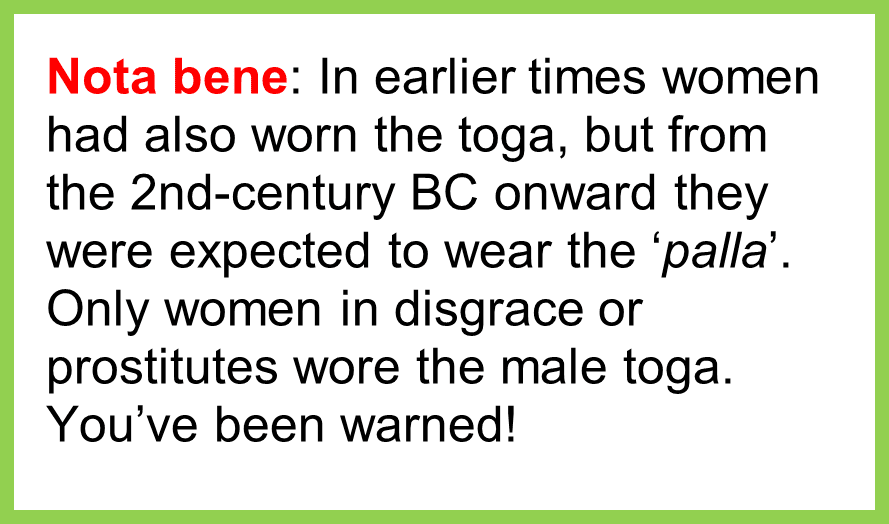
The himation was markedly less voluminous than the Roman toga, which was a very specific garment worn only by citizens. The toga was invariably made of wool cloth of varying sizes up to six metres (about 20 feet) in length. It was generally worn over a tunic with draped folds over the left shoulder and the excess material wrapped round the body in a swag. After the 2nd-century BC, the toga was worn almost exclusively by men and, as previously mentioned, only by Roman citizens.

For the Girls
  Searching for an appropriate costume for girls we discovered the ‘Grecian Goddess Costume’ (shown right). As for the boy’s tunic, we think this is one of the better offerings currently for sale, but it too comes with a few caveats:
  • Firstly, what is with the diaphanous strip of material? It serves no purpose, has no historical provenance, will probably get tangled and, as is so often the case in school, will most likely be discarded by the child. It is best gotten rid of.
  • The criss-crossing ‘gold’ belt is not a separate item but integral to the garment. Belts were, however, both functional in holding the dress closed about the body and decorative. Where we have surviving depictions of this cross-belted style, on statues for example, it seems the belt was crossed over the chest and tied at the waist. In this instance the belt is purely decorative, but it looks the part.
  • The dress is again ‘100% polyester’ but, as before, what should one expect for a costume retailing for less than £10. The shape and styling are surprisingly quite good and imitate the ankle length peplos (Greek: πέπλος) worn by respectable ancient Greek and Roman women from circa 500 BC, during the late Archaic and Classical period, onward.
Essentially, a peplos was a long, rectangular cloth draped about the body and left open on one side. The top edge was folded down about halfway, so that the folded-down portion gave the appearance of a second piece of clothing. The garment was then belted about the waist and the folded top edge pinned at the shoulders. In our opinion, the ‘Grecian Goddess Costume’ imitates that styling rather well.

Summary  As with most things you only get what you are prepared to pay for. Most of the children’s costumes for sale are cheap and cheerful but do not let that put you off. Some are slightly more ‘historically’ correct than others and we would recommend choosing these over the more dubious, clichéd offerings. Should you be inspired to make your own, then perhaps our guide to creating a simple ancient Greek or Roman costume, available here, might help.

Endnotes:

1. The quoted text is taken from the retailer’s description.

Thursday, September 30, 2021

Dispelling Some Myths: Chinese Ironworking

Hosted by the actor Danny Trejo, the US television series 'Man at Arms: Art of War', brought together martial arts experts and master blacksmiths to recreate some of the most popular weapons from movies, television shows and video games. The show is clearly intended to be entertaining, hence the graphic demonstrations of the featured weapons’ capabilities. Moreover, the addition of master blacksmiths to recreate the weapons provided useful insights into how they might have been forged. All good. Yet, at its heart this is supposed to be a factual documentary so, as keen historians, we are always alert to any claims made that seem, well, misleading.


Bold assertions
  Episode One of Season One, titled 'The Weapons of Kung Fu', focused on two ancient Chinese weapons, namely the 'Wind and Fire Blade' and the ji, a polearm. In the introductory sequence, in the so-called 'War Room', publisher of Kung Fu Tai Chi magazine, Gene Cheng, stated: 'China was way ahead of the rest of the world when it came to metallurgy.'

Blacksmith Kerry Stagmer, of Baltimore Knife and Sword, agreed: 'They were certainly mass-producing weapons in iron far ahead of anybody else. When so many other countries were struggling with just figuring out how to make it [iron] in the first place they were mass-producing. They were mass-producing weapons for armies with thousands of people in it. A big advancement over bronze.'

These are bold claims that, at best, are not entirely the truth. From the moment China's economic 'Open Door Policy' shifted to encouraging and supporting foreign trade and investment, starting on its path to becoming 'The World's Factory', access to and the study of Chinese history by western academics was notably improved. Consequently, documentary makers had a wealth of exciting new material to explore and broadcast to audiences in the West. This resulted in several factual TV documentaries revealing ancient Chinese technology in which it was enthusiastically asserted that China was far more advanced than the rest of the world. Understandably, given the premise of these documentaries, the focus on Chinese technological 'firsts' effectively ignored contemporary or competing innovations outside China to create a somewhat biased view. Such unbalanced and misleading claims are so frustrating, especially when one actually compares Chinese and European historical achievements. So, when it comes to the history of iron working, were the Chinese as advanced as the 'Man at Arms: Art of War' show implied?

The Iron Age
  In a subsequent piece to camera Cheng stated: 'China actually has the oldest metallurgy. They moved out of the Bronze Age into the Iron Age around about the Spring and Autumn period, some 3,500 years ago.' Not quite. The Spring and Autumn period [1], which roughly corresponds to the first half of the Eastern Zhou period, was from approximately 771 BC to 476 BC. At its earliest, therefore, it was about 2,800 years ago. Cheng effectively introduced a not unsubstantial error of nearly 700 years; still '3,500 years ago' does sound more impressive.

Leaving the pedantry aside, the Iron Age is conventionally defined by the widespread replacement of bronze weapons and tools with those of iron and steel [2]. That transition happened at different times in different places, as the technology spread. Mesopotamia was fully into the Iron Age by 900 BC. Although Egypt produced iron artefacts, bronze remained dominant until its conquest by Assyria in 663 BC. The Iron Age began in India about 1200 BC, in Central Europe about 600 BC and 300 years later in China (ca. 300 BC) [3]. This means China was somewhat behind in adopting iron, and it is still debated whether the technology of bloomery-based ironworking ever spread from the Middle East to China. Rather, in an example of 'simultaneous invention' [4], it is just possible that Chinese ironworking developed independently.

Cast iron  Returning to the show, Cheng then stated: 'The Chinese were the first to create cast iron. Now cast iron is a stepping-stone to steel, and the Han Dynasty, which is about the time of Christ, developed massive blast furnaces that could raise the temperature of cast iron hot enough to start creating steel. And that was centuries before any other culture developed it.' Once more Cheng’s claims are confusing both on the timing of these developments and his implication that the advance from cast iron to steel was a simple step achieved in a short period. The history of Chinese metallurgy is neither simple nor as unique and ground-breaking as the show would have us believe.

The earliest cast iron artefacts, dating to 5th-century BC, were discovered by archaeologists in what is now modern Luhe County, Jiangsu in China. Compare that date with the introduction of iron working to Greece in the 10th-century BC (see InfoBox right) and one begins to see that Cheng’s claim that China’s iron industry was 'centuries [ahead] of any other culture' does not stand up to scrutiny. That said, around 500 BC metalworkers in the southern state of Wu achieved a temperature of up to 1130 °C which is hot enough to use a hearth as a blast furnace. At this temperature, iron combines with 4.3% carbon, melts and in its liquid state it can be cast in moulds. This method of manufacturing objects is far less laborious than individually forging each piece of iron from a bloom as would have been the case in Iron Age Europe.

According to Wagner (1993) cast iron was subsequently used in ancient China for warfare, agriculture and architecture [5]. The claim regarding its use in warfare is surprising, and debatable, since cast iron is rather brittle and unsuitable for striking implements. It is far more likely, therefore, that cast iron was largely employed for non-military uses, for example by Chinese farmers.

If iron ores are heated with carbon to between 1150°C and 1200°C, a molten alloy of about 96.5% iron and 3.5% carbon is formed. This product is strong, can be cast into intricate shapes, but is too brittle to be worked. If, however, cast iron is heated in air for several days it is decarburized to remove most of the carbon to become wrought iron or a form of steel. The process is time and resource (fuel) consuming so the vast majority of Chinese iron manufacture, from the late Zhou Dynasty [9] onward, was of cast iron [5].

Toward the end of the Zhou Dynasty iron working methods spread northward. By 300 BC, about 150 years after the La Tène culture first appeared in Europe, iron became the material of choice throughout China for most tools and weapons. A mass grave in Hebei province, for example, dated to the early 3rd-century BC, contains several soldiers buried with their weapons and other equipment. The artefacts recovered from this grave are variously made of wrought iron, cast iron, malleable cast iron, and quench-hardened steel, with only a few, probably ornamental, bronze weapons.

Having been rather dismissive of the show’s claims it is worth noting that Cheng was correct when he said 'massive blast furnaces' were developed during the Han Dynasty (206 BC to AD 220). The government of the period established ironworking as a state monopoly and built a series of large blast furnaces in Henan province, each capable of producing several tons of iron per day. By this time, the 1st-century BC, Chinese metallurgists had discovered how to refine molten pig iron. By stirring it in the open air until decarburized it could be hammered to produce 'wrought' iron, or an early form of steel [10]. In modern Mandarin-Chinese, this process is now called chao, literally 'stir-frying', while pig iron is known, in translation, as 'raw iron' and wrought iron is known as 'cooked iron'.

Contrary to the assertions of this episode of 'Man at Arms: Art of War', one final example may be valuable. According to Needham (1986), the production methods of creating a form of high-carbon steel known as Wootz was an idea imported from India to China by merchants no earlier than the 5th-century AD [11]. So, the Chinese were no more innovative in iron making than many other cultures across the globe. This is not to dismiss China's ironworking methods, innovations or practical applications, but merely a reminder to place the country's achievements in a wider, world context.

Endnotes:

1. The period's name derives from the Spring and Autumn Annals, a chronicle of the state of Lu between 722 and 479 BC, which tradition associates with Confucius (551 - 479 BC).
2. Williams, D., (1867), "The Iron Age", Iron Age [weekly journal], New York.
3. Tylecote, R.F., (1992), A History of Metallurgy, Second Edition, Maney Publishing [for the Institute of Materials], London.
4. The concept of 'simultaneous invention' (more popularly known as 'multiple discovery') is the hypothesis that most scientific discoveries and inventions are made independently and more or less simultaneously by multiple scientists and inventors. As an example, stepped pyramids have been built by ancient peoples in South America, Egypt and Asia. It is probably safe to say that these people never met being separated by time and distance. What they share, however, is the ability to come up with similar solutions to similar problems independently (and all without 'Alien' involvement).
5. Wagner, D.B., (1993), Iron and Steel in Ancient China, BRILL, p. 408.
6. Riederer, J., & Wartke, R-B., (2009), "Iron", Brill's New Pauly: Cancik, H., Schneider, H. (eds.).
7. “Noric steel” is named for its place of origin, namely Noricum, an Iron Age kingdom located in modern Austria and Slovenia.
8. Craddock, P.T., (2008), "Mining and Metallurgy", in: Oleson, J.P. (ed.), The Oxford Handbook of Engineering and Technology in the Classical World, Oxford University Press.
9. The Zhou Dynasty (1046 BC to 256 BC) followed the Shang Dynasty (1600 BC to 1046 BC) and preceded the Qin Dynasty (221 BC to 206 BC). It lasted longer than any other dynasty in Chinese history (790 years).
10. Needham, J., (1986), Science and Civilization in China: Volume 4, Part 3, pp. 197, 277 and 563.
11. Needham, J., (1986), Science and Civilization in China: Volume 4, Part 1, p. 282.

Monday, September 20, 2021

Cury or Curry?

During a recent cookery demonstration at Berkhamsted Castle we were chatting to some visitors about the background and history of the recipes we had prepared (which, if you are interested, can be found here). The dishes had all been derived from The Forme of Cury ('The Method of Cooking'), an extensive 14th-century collection of English recipes, the original manuscript for which has been lost. Fortunately, however, the text of this historically significant cookery book can be recreated with some confidence because it was incorporated in nine other manuscripts. The most famous of the latter is a scroll with a headnote citing it as the work of 'the chief Master Cooks of King Richard II'. Some pedigree.

At this point one of the visitors noted the similarity of the Middle English [1] word 'cury' with the modern word 'curry' that describes much of Asian cuisine. The similarities in spelling and pronunciation of both words raised the question as to whether they share an origin. We thought it unlikely as contact and the exchange of ideas and language between 15th-century England and the Indian subcontinent was some 300 years in the future. Yet we could not be certain and thus promised to check. This is what we discovered.

Firstly, 'cury' is simply the Anglicised form of the Middle French [2] word cuire: 'to cook'. Whereas 'curry' was adopted and Anglicised from the Tamil word kari (கறி) meaning 'sauce'. This is usually understood to mean vegetables and/or meat cooked with spices with or without a gravy [3]. As to a linguistic connection, it is theorised that kari was first encountered in the mid 17th-century by members of the British East India Company while trading with Tamil merchants along the Coromandel Coast of southeast India [4]. Here, the British became familiar with 'a spice blend used for making kari dishes...called kari podi or curry powder' [3].

So, despite the outward similarities the two words 'cury' and 'curry' do not share an origin. Both words are clearly separated by both time and space.

Endnotes:
1. Middle English (ME) was a form of the English language spoken after the Norman conquest in 1066 until the late 15th-century.
2. The style of French spoken in the 14th- to the 16th-century and overlapping somewhat with ME.
3. Curry - Etymology (liquisearch.com)
4. Specifically at Fort St. George which was later called Madras and more recently renamed Chennai in 1996.

Friday, September 17, 2021

A Brief History of Foods: Lemons

The Lemon (Citrus limon) is a species of small evergreen tree in the flowering plant family Rutaceae. Believed to be native to South Asia, the true home of the lemon is unknown, although some have linked it to Northeast India (Assam). The Citron (Citrus medica) was the first of the family of citrus fruit to reach the Mediterranean [1]. The Citron spread West probably through Persia, where remains of a Citron were found in a 2,500-year-old Persian garden near Jerusalem, and through the Southern Levant (modern Israel, Jordan, Lebanon, southern Syria and Cyprus). During the 3rd- and 2nd-centuries BC, it spread to the western Mediterranean.

The earliest Citron remains found in a Roman context were discovered in Rome's Forum dating between the late 1st-century BC and the early 1st-century AD. Citron seeds and pollen were also found in gardens owned by the wealthy in Rome and the area around Mount Vesuvius. It took another 400 years for the lemon (Citrus limon) to reach the Mediterranean area and is supposed to have been introduced into southern Italy in AD 200. Citrons and lemons were not widely cultivated nor it seems did the Romans use lemons in cooking. However, it does seem that the wealthy Roman elite prized the trees for their decorative appeal in gardens, pleasant odour, healing qualities, symbolic use and rarity.

Around AD 700 Citrus limon trees were being cultivated in Persia, Iraq and Egypt [2][3], but it was not until the 10th-century that the lemon was first recorded in literature in an Arabic treatise on farming. Like the Romans lemon trees were also used as an ornamental plant in early Islamic gardens. Between AD 1000 and 1150 Arab traders distributed the lemon round the Mediterranean region [4], and the first substantial cultivation of lemons in Europe began in Genoa in the middle of the 15th-century. The lemon was later introduced to the Americas in 1493 when Christopher Columbus carried lemon seeds to Hispaniola. Subsequently, the Spanish conquest throughout the New World helped spread lemon seeds further still. Eventually, they were being grown in California in the years 1751-1768, and increasingly planted in Florida and California during the 19th-century.
The ellipsoidal yellow fruit of the lemon tree was initially used as an ornamental plant and in medicine [2]. It was, for example, prized for its medicinal virtues in the palace of the Sultan of Egypt and Syria in the years between 1174 and 1193. Scroll forward to the 18th-century and scurvy [5] was increasingly becoming a problem for the health of sailors on long sea voyages where they had limited access to fresh fruit. Although the connection between the disease and vitamin C was not fully understood, Scottish doctor, James Lind FRSE FRCPE (4 October 1716 – 13 July 1794), developed the theory that citrus fruits cured scurvy. A pioneer of naval hygiene in the Royal Navy, Lind conducted one of the first ever clinical trials on seamen suffering from scurvy to show the addition of lemon juice to their diets had a positive benefit to health.

Today lemons are used throughout the world for both culinary and non-culinary purposes. Although the pulp and rind are used in cooking and baking, it is the lemon's juice that is used for primarily both for culinary and cleaning purposes [2]. The juice is about 5% to 6% citric acid, with a pH of around 2.2, which gives a distinctively sour taste and makes it a key ingredient in drinks and foods.

An ingredient in lemonade, soft drinks, and cocktails, lemon juice is also used in marinades for fish where it neutralizes amino acids to delay the onset of decay. In meat, the acidic nature acts to partially breaks down tough collagen fibres and thus tenderise it. Lemon juice is also used as a short-term preservative on those foods that tend to oxidize and turn brown after being sliced, such as apples, bananas, and avocados. Known as enzymatic browning, the juice's acidity acts to denature the enzymes that cause the colour change.

Whole lemons are used to make marmalade, lemon curd and lemon liqueur, while lemon slices and lemon rind are used as a garnish for food and drinks. Lemon zest, the grated outer rind of the fruit, is used to add flavour to baked goods, puddings, rice, and other dishes. In Morocco, lemons are preserved in jars or barrels of salt which penetrates the peel and rind, softening them, and curing them so that they last almost indefinitely. The preserved lemon is subsequently used in a wide variety of recipes.


Endnotes:

1. Being the first is why the whole group of fruits are named after the Citron.
2. Morton, J., (1987), 'Lemon' in 'Fruits of warm climates', Miami, p. 160–168. Available online: https://hort.purdue.edu/newcrop/morton/lemon.html#Description, (accessed September 2nd, 2021).
3. The lemon reached China sometime between AD 760 and 1297.
4. Lemons did not arrive in Sicily before AD 1000 for example.
5. Scurvy is a disease resulting from a deficiency of vitamin C (ascorbic acid). It takes at least a month of little to no vitamin C in the diet before symptoms occur. Early symptoms include weakness, feeling tired and sore arms and legs. Without treatment, decreased red blood cells, gum disease, changes to hair, and bleeding from the skin may occur. As scurvy worsens there can be poor wound healing, personality changes, and finally death from infection or bleeding.

Edible Tudor England at Berkhamsted Castle

The motte-and-bailey castle in Berkhamsted, Hertfordshire, was built to control a key route between London and the Midlands as part of the consolidation of Norman power in England during the 11th-century. Surrounded by protective earthworks, and a deer park for hunting, the castle became the new administrative centre of the former Anglo-Saxon settlement of Berkhamsted. In later years, the castle was occupied variously by (amongst others) the Earls of Cornwall, Edward the Black Prince, Archbishop Thomas Becket, and even Geoffrey Chaucer. In the late 15th-century, the castle was occupied by Cecily Neville, Duchess of York (mother of Edward IV and Richard III). By then the castle had become increasingly unfashionable and, after her death in 1495, it was abandoned and fell into decline.
By the mid 16th-century, it was in ruins and unsuitable for royal use. Stone was taken from the castle to build houses and other buildings in Berkhamsted, and it was almost destroyed during the construction of the London and Birmingham Railway in the 1830s. As a result, the castle became the first building in Britain to receive statutory protection from Parliament and is now a scheduled ancient monument. In 1930, the castle passed from the Duchy of Cornwall to the government's control. Today it is managed as a tourist attraction by the Berkhamsted Castle Trust on behalf of English Heritage.
As part of the latter's 'Edible England' Heritage Open days, Tastes Of History introduced visitors to Berkhamsted Castle to late Mediæval and early Tudor food over two days in September 2021 (Sunday 12th and Monday 13th). In the shadow of the motte we pitched our display on the site of the original castle kitchens. Taking our inspiration from the Castle's cooks, all the dishes we served were taken from The Forme of Cury ('The Method of Cooking') [1], an extensive 14th-century collection of English recipes. Unfortunately the original Mediæval manuscript is lost, but the text can be recreated from its inclusion in nine other manuscripts. The most famous of these is in the form of a scroll with a headnote citing it as the work of 'the chief Master Cooks of King Richard II'. Given Berkhamsted Castle's royal heritage we felt confident that recreating recipes produced by the King's Master Cooks would be most appropriate. To that end we decided on a menu that included a 'Grete Pye', two types of tart, a chicken dish, two vegetable dishes and an old favourite, Lemon Posset.

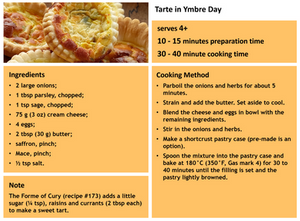
Tarte in Ymbre Day  In the Mediæval Church calendar Ember Days were celebrated four times a year; the word 'ember' (or 'Ymbre') is derived from the Latin phrase Quatuor Tempora meaning 'four times'. Ember Days were observed with fasting (no food between meals) and half-abstinence, meaning that meat was allowed at one meal per day. For those folk who wished to avoid meat completely, then a tart made principally with dairy products which were permitted (cheese, eggs, butter, etc.) makes eminent sense.
Tart de Bry  Alongside Ember Day tarts we also offered 'Tart de Bry', where the name provides a clue to its filling of Brie cheese.
Grete Pye  Pies were very popular in Mediæval and Tudor England. Unlike today, however, this game pie used a pastry that was not intended to be eaten. Rather, the hot water crust was needed to contain the filling and act like a baking tin. When delivered to the table during a Tudor feast as part of a 'mess' [2], the pie lid would be removed and the content shared among the diners. Each person would transfer the filling to their 'trencher' or plate before eating.
Hennys in Bruet  Otherwise known as 'Chicken in Cumin', Hennys in Bruet is an English variation of a popular dish in western Mediæval Europe. In France it was known as 'Cominée' indicating the characteristic seasoning with cumin.
Buttered Wortes  The Old English word 'wortes' is the plural form of 'wort' and simply means 'leaves'. This dish, which we have recreated for the annual commemoration of the Battle of Bosworth Field and frequently include in Sunday lunches, is tasty way of serving leafy greens. Lightly frying boiled cabbage or spring greens in a generous quantity of butter with leeks and seasoned with pepper is perhaps indulgent but delicious.
Chebolace  It is not always easy to identify a historically correct recipe that is suitable for vegetarians. Roman dishes, for example, typically include fish sauce as a flavour enhancing ingredient. Cherbolace, however, was an option that satisfied at least one visitor who singlehandedly polished off a whole bowl. It is a simple savoury green soup spiced with coriander made from onions, spinach and, in this instance, kale.
Lemon Posset  And finally, we could not resist offering visitors the ever popular lemon Posset. In this version, however, no sugar was added to the cream to balance the sharpness of the lemon. While the first record of sugar in English dates from the 13th-century, we thought it appropriate to leave sugar out since at the time of Cecily Neville's residence in the castle it still would have been an incredibly expensive import. We were keen to discover whether the absence of sugar would affect the flavour. As it turned out Lemon Posset remained a big hit with visitors.
The Final Word  Our especial thanks go to incredible staff and volunteers from Berkhamsted Castle Trust who not only organised the 'Edible England' event but made us feel so welcome.

Please feel free to like, share or comment. And if you are inspired to try the recipes, then bon appétit.

Endnotes:
1. Cury comes from Middle French cuire: 'to cook' (spoken in the 14th- to the 16th-century).
2. Circa AD 1300 the noun 'mess' meant 'a supply or provision of food for one meal'. The word in English is derived from the Old French mes meaning a 'portion of food' or a 'course at dinner'. This sense is itself derived from Late Latin missus for a 'course at dinner' (in the literal sense it meant 'a placing', for example, on a table). The notion that a 'mess' meant 'a communal eating place' (especially a military one) is attested by the 1530s. This is a development from the earlier 15th-century sense of 'a company of persons eating together at the same table', originally a group of four.